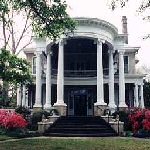
The House on Montrose Street
Little Odessa Bowman briskly walked down Montrose Street, her head held down, frequently casting furtive glances at the enormous, beautiful houses set back from the road amidst sprawling, green velvet lawns and fragrant, colorful gardens. Odessa was accorded the privilege of walking down the scenic street because her mother worked as a maid for the affluent Arlington family, who lived at number seventeen.
Normally, only those "colored" folks who were employed as butlers, housemaids, cooks, handymen, gardeners and chauffeurs were allowed on Montrose Street. All others who dared wander into the strictly segregated neighborhood were quickly, and sometimes forcibly, shown the way out, for the wealthy whites who dwelled on Montrose Street (all descended from those revered heroes who fought on the side of the Confederacy) did not look kindly on having "nigras" step out of the station into which they had been cast by the fine Christian forefathers of the Southern white community.
Odessa clutched her schoolbooks to her chest as she headed toward the Arlington home. She could see aversion and suspicion in the eyes of the white people she passed. If she resented being treated as an unwanted intruder, she gave no indication of it. She was, after all, only nine years old, and this was the South of the early 1950s, a time before the Montgomery bus boycott, the Southern Christian Leadership Conference, the Reverend Martin Luther King's famous "I Have a Dream" speech at the Lincoln Memorial and the eventual signing of the Civil Rights Act of 1964. Odessa had yet to hear of people such as Rosa Parks, James Meredith, Malcolm X or Medgar Evers.
The little girl continued to make her way toward number seventeen, with her head down and eyes averted until, finally, the Arlington mansion loomed up before her. Odessa walked up the driveway to the servants' entrance at the side of the house. Sissy, the black cook, opened the door to let her in. Not long after Odessa entered the Arlington kitchen, she spied her mother walking toward the clothesline in the backyard, carrying an empty wicker laundry basket. Odessa left her books on the table and ran out the back door.
"Hi, Mama," she called happily.
"'Dessa, honey!" Sophie Bowman cheerfully greeted her only child. "You home from school so soon?"
"It's after four o'clock, Mama."
"Is it? Good heavens, I must be gettin' old. I shoulda been finished with all this laundry by half past three. Oh, well, all I have left to do is bring in the clean clothes from off the line. Then we can go on home, chil'."
"Let me help you, Mama," the girl offered. "You look tired."
"Don't you bother your pretty head about this here laundry. You go back inside and finish your homework. You got to get yourself an education. You hear me, 'Dessa? I don't want you growin' up like me, havin' to clean other people's houses for the rest of your life."
"Someday, Mama, I'm goin' to take care of you," Odessa promised, as she threw her arms around her mother's frail body. "I'm gonna be rich, and I'll buy you a fine house right here on Montrose Street. And we'll hire someone to clean up after us and do our laundry."
The exhausted maid laughed.
"I don't know where you get your ideas, gal. You're old enough to know that no black folks are allowed on Montrose Street, less'n they're cleanin' up after the white folks."
"Someday, Mama, all that will change. You just wait and see."
* * *
Unfortunately, Sophie Bowman never lived to see her daughter's prophecy come true. The widowed housemaid died of ovarian cancer when Odessa was only fourteen years old, while Dwight D. Eisenhower was still in the White House. Unlike her child, she did not live to witness the winds of change that began to blow when John F. Kennedy took over the Oval Office.
Sophie was laid out in a second-hand dress provided by a local charitable organization. A brokenhearted Odessa stood beside her mother's coffin, observing the mourners who came to pay their final respects to her mother. Not a single member of the Arlington family was present; in fact, not one white face appeared in the crowd. Sophie had cleaned the Arlington house for close to twenty years. She babysat the Arlington children when she was asked and nursed them when they were sick. Yet not one of the members of the family cared enough to come to the viewing.
Odessa, her cheeks wet with tears, knelt in front of the cheap wooden casket and took her mother's cold, dead hand in her own.
"I'll keep my promise to you, Mama," she quietly vowed. "No matter what I have to do to get there, I swear I'll end up on Montrose Street. I'll do it for both of us."
Barely a week after her mother's burial, Odessa was sent to live with Wilhelmina Bowman, her late father's unmarried younger sister, in Philadelphia, Pennsylvania. In her new school, the determined teenager worked hard and earned good grades, and when she graduated from high school, she applied to and was accepted at a nearby college.
Before classes were to begin, however, Odessa changed her mind about furthering her education and decided to join a group of Civil Rights activists instead. Like so many young people of the Sixties—both black and white—Odessa marched for peace in Vietnam and for equal rights for women and minorities.
With all the naivety of youth, she honestly believed that she and her friends could change the world with their peaceful protests and make it a better place. Regrettably, the assassinations of Dr. Martin Luther King, Jr., President John F. Kennedy and his brother, Senator Robert Kennedy, as well as the escalation of the war in Vietnam, dampened the young woman's zeal.
Finally, she came to the inevitable conclusion that she must see to her own future and let the world look after itself. With renewed determination, Odessa went to college and received her degree in 1973. After graduation, she was able to get a good job in a newly emerging computer company, thanks to its affirmative action plan.
At the age of twenty-seven, the successful career woman met Darnell Riverton, a twenty-eight-year-old computer technician from New Jersey, and the two dated for over a year. Rapidly approaching his thirtieth birthday, the young man felt it was time to settle down. Darnell wanted to get married and raise a house full of happy, healthy children. Odessa, on the other hand, like many females in the 1970s, began to question the role of women in society. She had gone to college and set out on a career path. Why should she give up what she had worked so hard for just to get married? Baking casseroles and turning out a baby every two to three years did not appeal to her in the least.
Besides, she had ambitions of climbing up the corporate ladder and of becoming as wealthy as the Arlingtons had been, for even after all that had happened since she was a little girl, she had not forgotten the promise she made to her mother: to someday live in one of the grand houses on Montrose Street.
Predictably, the romance with the technician withered and eventually died. There would be other men in Odessa's life, but she would never feel for them what she had felt for the man who had proposed marriage to her.
While her personal life was less than satisfactory, her professional life was right on track. With periodic promotions and regular salary increases, Odessa's annual income grew to a six-digit figure. Yet despite her upper-tax-bracket earnings, the talented computer programmer led a very simple, austere life. She lived in a small, sparsely furnished studio apartment in one of the less fashionable sections of Philadelphia. Her wardrobe, though tasteful and appropriate for her position, was small. She did not waste money on cosmetics, jewelry, cars, vacations or entertainment. Every dime she could spare went into sound investments.
* * *
Shortly after turning fifty, the still-unmarried Odessa Bowman met with Rupert Spidey, her financial advisor, to discuss the status of her various investments.
"Did you have a chance to read the latest statement I FedExed to you?" the aging former certified public accountant asked with professional pride.
"Yes, I did, Mr. Spidey. The stock in that pharmaceutical company you advised me to buy last year is doing very well, and the Mikel stock is still climbing."
"I'm pleased to say that you are now a very wealthy woman, Ms. Bowman."
"Due in no small part to your brilliant financial advice," Odessa added graciously.
"Thank you," Rupert responded with an I-told-you-so look on his face. "Optimistically, I would say that in another two or three years you could retire and live quite comfortably."
"Actually, I'm thinking of selling my stocks now and purchasing a piece of property."
The financial advisor's eyes widened with interest. He was always on the alert for tips on new investments.
"Property? Where? What have you heard?" Spidey eagerly inquired.
"I'm not talking about investment property. I want to buy a house to live in."
"You needn't touch your stocks then," he pointed out. "Given your excellent credit rating, you would have no difficulty at all getting a low-interest mortgage."
"No. I want to pay cash."
Rupert balked.
"Cash? Don't be ridiculous, Ms. Bowman! No one pays cash anymore. There are no tax advantages to paying cash."
Odessa did not give a damn about tax shelters, penalties for early withdrawals, her credit score or lower interest rates. She could only think about the Arlingtons, the Beauregards, the Jacksons, the Pembertons and the other wealthy denizens who lived on Montrose Street. They did not carry mortgages. Their homes had been passed down through their families and preserved for generations by marriages within the same social circle. Although Odessa could never become one of the socially prominent white residents who descended from the antebellum planter aristocracy, she would at least own her house free and clear.
"Precisely how much are we talking about?" Rupert asked, hoping to minimize the damage to his client's portfolio.
"Frankly, I have no idea. I haven't found the right house yet. I plan on taking a few weeks off from work to check out the real estate market. But first, I wanted to see just how much I'd have if I were to liquidate my assets."
The conscientious financial advisor sighed with relief. If Ms. Bowman had not found a house she liked yet, there was still a chance she might change her mind.
* * *
Odessa had not been south of the Mason-Dixon Line since her mother passed away, so she purchased a car and took a sentimental journey back into her childhood. Her first stop was the Mandeville Church Cemetery, where she placed fresh flowers on her mother's grave.
"I did it, Mama," she triumphantly announced, wiping the tears from her eyes. "I went north to live with Aunt Wilhelmina, attended college and got a good job just like you always wanted me to do. Furthermore, I intend to keep that promise I made to you. I've come back to Mandeville a rich woman, and I'm going to buy a house on Montrose Street like I swore I would."
After leaving the cemetery, Odessa drove to the colored section of town, separated from the vicinity of Montrose Street by the homes of middle- and lower-middle-class whites.
"My old neighborhood hasn't changed at all," Odessa noted, standing in front of the small, run-down, two-room house where she was born. "Except for the fact that everything looks even smaller than I remembered it."
As she stood on the dirt road staring at the front of her former home, the screen door creaked open, and two children ran outside to play. They stopped abruptly when they saw Odessa standing there.
"Who are you?" the little boy bravely inquired.
"My name is Odessa Bowman, and I used to live in this house. I was born here, as a matter of fact."
"How come we never seed you in there then?" the boy's little sister wondered.
"Because that was fifty years ago, long before you two were born."
"Did you come back here to live in our house?" the boy wanted to know.
"Oh, no," Odessa laughed and proudly announced. "I'm going to buy my own house over on Montrose Street."
That's odd! she thought.
Neither the little boy nor his sister looked surprised at her claim. At their age, Odessa would have been flabbergasted at the notion of a woman of color being on Montrose Street for a reason other than working as a servant for one of the white families who lived there.
* * *
As Odessa turned the corner of Magnolia Street and Amaryllis Lane, she began to feel the gentle tremors of anticipation. She could imagine the wide-eyed, open-mouthed, shocked expressions on the Old Guard's faces as a black woman drove up Montrose Street in a brand-new Mercedes, an extravagance the computer programmer felt was justified by the occasion.
Soon thereafter, with bated breath, she neared the intersection with Montrose Street—only three blocks ahead of her. It had taken her almost forty years to work her way back here, years of loneliness, self-deprivation and sacrifice. While other women had fallen in love, married and had families and friends, she had remained focused on one goal: to end her days in one of the fine houses on Montrose Street.
Odessa turned the final corner. A few minutes later, she pulled the Mercedes to the side of the road and parked across the street from number seventeen. Several white people were sitting outside the house in lawn chairs and porch swings. They turned to look at the unknown black woman with the pricey car, but they were not surprised to see her. Rather, it was Odessa herself who stood open-mouthed with astonishment in the middle of Montrose Street, staring at the once-grand house.
The spreading urban blight had managed in forty years to encroach upon this hallowed ground, so much so that the Arlingtons, Beauregards, Jacksons and Pembertons sold their family homes and moved to more upscale communities. Their former mansions, though in pristine condition when Odessa last saw them, had long since fallen into disrepair. The paint was chipped and faded, the shutters hung askew, the screens were torn and, in several cases, the window panes were shattered. Furthermore, the once well-manicured lawns and gardens were now suffering from neglect.
The neighborhood had been rezoned for commercial use, and many of the houses had been subdivided. The Beauregard mansion was now a nursing home, and the Jackson home housed a real estate office on the lower level and low-income apartments on the upper floors.
"Dear God! It was all for nothing," Odessa cried bitterly.
Too late, she comprehended the cruel truth of her situation. She had been obsessed with the dreams of a pre-adolescent child. Having been a victim of the segregation of the Fifties, she had become a slave to the belief that people's worth was to be judged by the color of their skin, the size of their bank account or by the elegance of the home and neighborhood in which they lived.
In contrast to her grim reality, Odessa thought of what might have been. She imagined herself married to Darnell Riverton, the computer technician, having grown children, grandchildren and a nice, modern home in the Philadelphia suburbs. She might have been happy in those surroundings. Feeling the sharp bite of hopelessness and disillusionment, Odessa fell to her knees and wept.
Suddenly, a delivery truck turned onto Montrose Street. The driver had a long, busy day ahead of him, almost double the number of packages to deliver than the normal amount for that time of year. Consequently, he was speeding from one delivery to the next. After rounding the corner, he put his foot on the gas and turned his head to read the numbers on the houses. Distracted, he failed to see the well-dressed black woman kneeling in the middle of the road until it was too late to stop.
* * *
A small group of mourners gathered around Odessa's stainless steel casket. Her Aunt Wilhelmina had taken a bus from Philadelphia, and several of her business associates had flown down on the company plane. After the brief service, a handsome, middle-aged man approached Odessa's elderly aunt, introduced himself and offered his condolences.
"Riverton? You're the young man who wanted to marry my niece, aren't you?"
"Yes," Darnell confirmed, "but that was years ago, ma'am."
"She talked about you, from time to time. She often wondered how you were doing."
"I thought about her a lot, too."
Aunt Wilhelmina looked down at her niece, dressed in a chic designer suit, lying peacefully in her expensive casket with her eyes closed in eternal slumber.
"She should have married you, you know. I think you would have made her happy."
"Odessa had a dream to fulfill, one she had long before she met me."
The grieving aunt nodded sadly.
"Yes, that damned dream of hers."
Darnell took the old lady's arm and gently led her out the door. She stopped at the bottom of the steps, turned and looked up at the not-so-grand mansion at number seventeen Montrose Street, once the home of the wealthy Arlington family but now the Williams Funeral Parlor.
"Congratulations, Odessa," her aunt muttered. "Your dream has come true at last. You got to end your days in the fine house on Montrose Street, just like you always vowed you would."

Salem swears he will one day live in his own mansion, but for now he's content to stay in my saltbox. (Lucky me!)


