The Sunday School Teacher
Today many people nostalgically remember the 1950s as the calm before the stormy '60s, yet their memories are often clouded with unrealistic images seen on television. Old programs all too often painted an inaccurate picture of the times. In reality, father did not always know best, and few families were as functional as the Cleavers, the Andersons and the Stones.
While the Whipples considered themselves an average American family, neither of the parents could deny that there was something "not quite right" about their ten-year-old son, Alfie. Of course, there was nothing glaringly wrong with the boy. He was just a little too quiet. He also developed a bad habit of staring at people, a tendency that unnerved young and old alike. Other children often described Alfie Whipple as "weird"; adults thought him "odd." His thick glasses and his penchant for spending his free time with his nose buried in a book earned him the reputation of being an egghead, but his grades were hardly honor roll caliber. Both his parents and his teachers assumed that the boy was just not working to his potential, yet the truth was the books Alfie read were not ones his teachers would deem as having educational value. The stories he liked best were of western outlaws and Chicago gangsters.
Unlike many American youngsters of his day, he had no interest in Dracula, Frankenstein or the Wolfman. He was smart enough to know that the dead did not come back to life and that people did not turn into a wolf when the moon was full. Whereas men like Dillinger, Capone, Billy the Kid and Jesse James had actually lived, breathed and terrified law-abiding citizens. In fact, Texas, where he and his parents lived, had seen more than its share of such robbers and cutthroats.
Of all the gun-toting felons to plague the Lone Star State, Bonnie Parker and Clyde Barrow were Alfie's favorites. Two young "kids" from the Dallas area, this deadly duo had robbed banks, armories, gas stations and stores and led the police on a chase through Texas, Oklahoma, Missouri, Arkansas and Iowa before they met their untimely end in Louisiana in 1934.
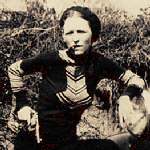
Alfie first read about the couple in a book written by a former Texas Ranger who had taken part in the ambush in which the two young lovers were killed. While the boy found nothing particularly remarkable about Clyde Barrow—after all, he was no Public Enemy Number One—he was fascinated by Bonnie Parker. In part, Alfie was mesmerized by the photograph of a petite young woman standing with her leg up on the fender of a car, holding a cigar in her mouth and a gun at her hip. He was also impressed that she was a woman in a field dominated by men. She and Ma Barker were not just gangsters' molls; they actually took an active part in the robberies.
* * *
One day in 1953 when Alfie was walking home from school, he stopped at the curb to get the mail. There were never any letters for him, so he did not bother looking through the stack of envelopes. When he walked into the house, he saw his mother on her knees washing the kitchen floor.
"Here's the mail, Ma," he called.
"Just put it on the table," she replied. "Probably nothing but bills anyway."
It was then that Alfie noticed the return address on one of the envelopes. The name of the sender was Henry Barrow, and the address was one in Dallas. While Barrow was not an uncommon name, many of the Barrows in Dallas were related in some way to the slain outlaw.
"What's that?" his mother asked, as she took off her soapy rubber gloves.
"Just a letter."
"Is it from your Aunt Effie? Let me see."
Mrs. Whipple took the letter and glanced at the front of the envelope.
"It's not for us. It's for Mrs. Frasure. The postman must have put it in our mailbox by mistake. Will you do me a favor? Go across the street and give this to her."
"Sure, Mom," he replied.
Alfie took the letter from his mother's hand and walked to the neighbor's house. When Mrs. Frasure answered the door, her smile faded slightly at the sight of the child. Like most people, she felt uncomfortable around the strange, quiet little boy with the thick glasses.
"What is it, Alfie?" she asked politely. "Are you here to sell me Christmas cards again?"
"This is yours," he said, handing her the letter.
Mrs. Frasure quickly glanced at the envelope. Her face paled when she saw who had sent it.
"Th-thank you," she managed to stammer, only slightly aware of the boy staring intently at her.
As Mrs. Frasure closed the door, Alfie saw a look of anguish on her face.
* * *
Alfie woke early Saturday morning to do his chores.
"What got into you today?" his mother asked when she saw him cleaning his bedroom before breakfast.
"I want to get done so I can go to the library."
When he finished the last of his assigned tasks, Alfie headed for town. He already knew which section to go to: 364, where books on criminology were kept. (As a frequent visitor to the library, he often gave silent praise to Melvil Dewey for inventing his decimal-based system of organizing books.)
He was searching for the book written by the former Texas Ranger when he spied a new book on the shelf: The True Story of Bonnie and Clyde. Alfie's heart leaped with joy when he saw a book dedicated to his favorite bank robbers! Since there were over three hundred pages, he decided to check the book out at the front desk. That way he would have three weeks to savor it.
Less than ten pages into the book, Alfie came across the name of Clyde Barrow's father. It was the same as the one on the letter sent to Mrs. Frasure: Henry Barrow.
What if it's the same man? he thought excitedly.
That question gave birth to another.
If it is, why is Clyde's father writing to Mrs. Frasure?
* * *
The following morning at breakfast, Alfie broached the subject of the neighbors to his parents.
"How long have the Frasures lived across the street?" he asked.
Mr. Whipple looked up from his Sunday paper and replied, "I believe they moved in not long after you were born. Why?"
Alfie shrugged his shoulders.
"Just curious. My teacher said people in big cities don't take the time to get to know their neighbors, but people in the country and small towns have to rely on each other. So, I thought I should learn more about Mr. Frasure and his wife."
Lies came as natural to the boy as breathing.
"I think that's an excellent idea," Mrs. Whipple declared as she put a plate of scrambled eggs, bacon and toast in front of her son. "What would you like to know about them?"
"Where they come from, if they have any family nearby—that kind of thing."
Mrs. Whipple poured out orange juice and sat down to eat her own breakfast.
"Well, let me see. Mr. Frasure is an engineer and a former Navy man. Both he and his wife attend church in town where Mr. Frasure sings in the choir and Mrs. Frasure teaches Sunday school."
A Sunday school teacher? Alfie was amazed. Why was a Sunday school teacher getting letters from the father of a notorious gangster? His parents had little more to add. The fact that Mrs. Frasure liked to ride horses and garden or that Mr. Frasure liked to dance did not interest him at all.
After breakfast, the family went to church. While Alfie rarely paid attention to the minister's boring sermons, that Sunday was worse than most. The service dragged on interminably. When it was finally over and the Whipples returned home, their son raced upstairs to his bedroom and his library book.
* * *
It was an ordinary Sunday afternoon. Downstairs in the kitchen, Mrs. Whipple was peeling potatoes and carrots to put in her stew. In the living room, Mr. Whipple was watching a football game on the family's new RCA console television. Neither parent was aware that on the floor above them, their son was about to make an astounding discovery.
Alfie had just finished reading a chapter in his book that ended with a paragraph stating that Clyde's brother had received a pardon and was to be released from prison. The boy reached over to his night table, got one of his mother's homemade chocolate chip cookies, turned the page and began the next chapter.
The author wrote an account of Bonnie and Clyde renting a garage apartment in Joplin, Missouri, where, along with a young cohort, they planned on spending some time with Clyde's brother, Buck, and Buck's wife, Blanche. Alfie's fingers tightened around the book as he read about the ensuing gunfight with local lawmen as the fugitives made a dramatic escape followed by Buck and Blanche's somewhat reluctant induction into the Barrow Gang.
Alfie turned the page again. The narrative was interrupted by two pages of photographs. The picture on the left page was of Bonnie jokingly holding a shotgun pointed at Clyde's midsection. The one on the right was of a man sitting on the running board of an old Ford, with a young, dark-haired beauty on his lap. The caption identified the couple as Buck and Blanche Barrow. Despite the passage of twenty years, Alfie could see the strong resemblance between the woman on Buck's lap and the Sunday school teacher who lived across the street.
It was not until he had read another hundred and fifty pages that he learned of Buck and Blanche's parting with Bonnie and Clyde. The Barrow Gang was staying at a tourist camp in Platte City, Missouri. While they slept, lawmen gathered outside. The gang was able to shoot their way out of their predicament and escape, but during the gun battle, Buck was shot in the head and Blanche was wounded in both her head and her eye.
After a harrowing drive through fields and along country roads, the Barrows eventually crossed into Iowa and camped inside an abandoned amusement park where they tangled with the law again. Bonnie and Clyde managed to escape, but Buck, already seriously wounded, was shot again, after which he and Blanche were taken into custody. Buck later died in an Iowa hospital. Soon after, his wife was sent to a penitentiary in Missouri where she was sentenced to serve ten years.
The book did not end there. The author carried the story to its bloody conclusion, to the day when Bonnie and Clyde were ambushed by a six-man posse in Gibsland, Louisiana, led by Texas Ranger Frank Hamer. For the time being, however, Alfie was not interested in learning the details of the final chapter in the history of the Barrow Gang. He was too excited by what he had read of Blanche's fate.
"She didn't die like the others," he said with surprise. "That means she might still be alive!"
* * *
When Alfie got the mail for his mother, he looked around to see if anyone was watching. Seeing the coast was clear, he opened the Frasures' mailbox and scanned the names on the envelopes inside. Most were addressed to the man of the house, but there was one magazine addressed to Mrs. Blanche Frasure.
Blanche! Alfie caught his breath. Was Mr. Frasure really Blanche Barrow, one of the infamous Barrow Gang? The very idea seemed ludicrous. She was an ordinary housewife who lived in a house with a picket fence and a flower garden. She went to church every week and even taught Sunday school.
Alfie put the mail back in his neighbor's box, holding one letter out and tucking it inside the pile of envelopes for his family. When he entered the house and handed the mail to his mother, he waited nearby until he heard her complain that the mailman had given them the Frasures' mail again.
Her son stepped forward, trying not to appear too eager.
"I'll take it across the street," he volunteered.
When Mrs. Frasure opened the door, Alfie cleverly held up the envelope with his left hand.
"We got your mail by mistake again."
Mrs. Frasure's good eye followed the letter in the boy's hand, but her bad eye, injured during the escape from the tourist camp in Platte City, looked straight ahead.
Alfie's breath quickened with excitement. As incredible as it seemed, his church-going, Sunday-school-teaching neighbor was Blanche Barrow.
* * *
It has often been said that knowledge is power. It has further been stated that power is like muscle—you either use it or lose it. Alfie's knowledge of Mrs. Frasure's true identity was a power he might hold over her. But to what end? Should he blackmail her? If he did, what would he get out of it? He was still too young to have a real appreciation for the value of money. Besides, he did not want to confront her with his knowledge. The Barrow Gang had not hesitated to kill when they were in danger; and while he did not believe Mrs. Frasure was a cold-blooded killer herself, one could never be sure.
So how was he to exercise his newly found power? Alfie looked out his bedroom window at the neat, well-kept house behind the white picket fence. It did not seem fair to him that Blanche lived in such comfort while Bonnie, Clyde and Buck were in their graves.
"She got off too easy," he grumbled.
It then occurred to the boy that it was in his power to make her pay for her crimes, and he smiled at the thought.
* * *
Mrs. Frasure trembled as she held the postcard of Joplin, Missouri, in her hand. On the back were scrawled the words "I miss you. Love, Buck." Joplin. It had been the first page in a chapter of her life she wished to forget. She would always love Buck, but she took great pains to keep her life with him hidden. She had served her time and after release from prison, she married and lived a model life. Now, with one postcard, all the horror of the three and a half months she was on the run with Bonnie and Clyde came flooding back to her: the deadly shootouts with the police, all the nights spent sleeping on the ground in woods or open fields, the fear of impending death and the loneliness of being cut off from her family.
Blanche took the card up to her bedroom and removed a wooden box from her closet shelf. Inside were several mementos from her more disreputable past: photographs, newspaper clippings and letters. They were all she had left of the young bank robber she fell in love with during the bleak days of the Great Depression. Upon seeing the photograph of Buck, all the old feelings that she had tried to keep in check came flooding back.
* * *
The next day's mail brought a postcard from Platte City, the town where Buck was shot in the head and where she was shot and got glass in her eye. Her hand shaking, she turned the card over and read, "I miss you. Love, Buck. It never occurred to Blanche that even if Buck was still alive, he could not have sent the postcards since he was illiterate. As far as she was concerned, they came from her late husband, even if his spirit had written them through someone else's hand.
Once again, she went up to her room and placed the postcard in the box with the old letters and photographs. She took out a newspaper clipping that told how Bonnie and Clyde had escaped from the abandoned Dexfield Park and how police had captured Clyde's mortally wounded brother and his hysterical wife.
Blanche closed her eyes and wept as she remembered that day. It had been five days after the shooting at Platte City. The Barrow Gang spent the night asleep on the ground, except for Buck who was placed on a car seat so that he could rest more comfortably. Blanche's clothes and hair were matted with blood. Although exhausted, she forced herself to remain awake, fearing that if she slept Buck would be dead when she woke up.
What followed was a nightmare! A posse formed by Sheriff C.A. Knee, consisting of nearly a hundred law enforcement officers, National Guardsmen and armed, deputized citizens, surrounded the makeshift campsite. The gang's escape was thwarted when Clyde backed his car up and got it stuck on a tree stump. Unable to get the vehicle free, the fugitives tried to escape on foot, but Buck was too weak to get far. As Blanche and her wounded husband lay beside the trunk of a fallen tree, she tried to cover him with her own body. Yet despite her valiant efforts to protect him, he was shot six times in the back.
Blanche knew it was only a matter of time before they were both killed. But with medical care, there was a chance Buck might be saved. Thinking only of her husband, she bravely stood and surrendered. Sadly, Buck later died in the hospital. Ten months after their escape, Bonnie Parker and Clyde Barrow were also dead.
"At least they died together," Blanche said with a sigh.
* * *
Blanche nervously paced the floor, fidgeting and making a half-hearted effort to clean her house. Her good eye repeatedly looked to the hall clock, counting down the hours and minutes until the postman was due to arrive, sometime between 3:00 and 3:30. At 2:45 she stood in front of her living room window where she saw the Whipple boy arrive home from school. He glanced at the mailboxes, noticed the red flags were not up and went inside his house. Unbeknownst to her, he, too, stood sentry, waiting for the postman.
The hall clock ticked off the seconds, and at 3:00 the chimes sounded. Ten minutes later, the postman turned the corner and headed up the street. He cheerfully greeted Mrs. Frasure when he handed her the mail.
The odd little boy with the Coke bottle glasses smiled down from his bedroom window. The postcards had only cost him a nickel a piece down at Woolworth's. They had been quite a bargain.
Inside her home, Blanche tossed aside the bills and magazines and even a letter to her from Buck's sister, Marie. Nothing! No word from Buck today. What if he never tried to contact her again? Her heart sank. It was like losing him all over again.
"Oh, Daddy!" she sobbed, using her pet name for him, as she bent over and picked up the discarded mail.
There it was! She missed it the first time because it had been stuck to a request for donations from the March of Dimes.
The picture on the card was not immediately recognizable because the Barrow Gang had seen the park only after it was closed down, not to mention the fact that they had been more concerned with staying alive than with admiring their surroundings.
"Dexfield Park! This was where we were captured," Blanche said.
She turned the card over, expecting the same message she had received the previous two days. This one, however, read, "I'm waiting for you. Love, Buck."
* * *
Alfie Whipple had been at his window for more than half an hour, and he did not see anything out of the ordinary in the house across the street. Perhaps the postcards did not bother Mrs. Frasure. Maybe she saw them for what they were: a childish prank played by a lonely, rather odd little boy.
Suddenly, Mrs. Frasure burst out of her front door, buttoning her sweater as she hurried down her walkway. She opened the garage door, got into her car and raced off, leaving a cloud of dust behind her. The former Mrs. Barrow had been in such a hurry that she did not even bother to shut the garage door.
"I wonder what got into her," Alfie heard his mother say as Mrs. Frasure's car sped down the road.
For the first time, Alfie wondered if his little prank might get him into trouble.
* * *
Mrs. Frasure drove for hours, never easing up on the gas, and stopping only once to refuel. She had always been a good driver, albeit a fast one. Her skill had served her well when she rode with the Barrows since on more than one occasion she was called upon to drive a getaway car.
Her good eye began to burn, and she wanted to pull over and sleep. But she made herself keep going. When she crossed the Iowa state line, she pulled into a gas station, filled her tank and bought a map.
Mrs. Frasure had some difficulty finding the place in the dark. Thankfully, most of that part of the state had not changed much during the past twenty years. She turned off the main street, drove down a dirt road referred to as Lover's Lane, parked her car and walked the rest of the way. As she neared a clearing in the woods, she heard voices and could detect movement around her. The darkness seemed to lift like a morning fog. In the growing daylight she saw Bonnie and Clyde eating food they had cooked over a campfire. Not far away, Buck lay on the car seat. A young Blanche hovered over him, willing him to live.
To her right, Mrs. Frasure heard a shot ring out.
"No!" she screamed.
No one seemed to notice her.
Are these ghosts? she wondered.
But surely the young Blanche was not a ghost, for she was still very much alive.
Mrs. Frasure watched in horror as the events of her past unfolded before her eyes. Unable to do anything to change them, she could only weep and wait for the inevitable, tragic outcome. She watched Clyde get his car stuck on a tree stump, making it necessary for the fugitives to escape on foot. Blanche and Buck tried to follow, but they fell behind and were soon separated from Bonnie, Clyde and W.D. Jones. The terrified young woman led her injured husband to a large fallen tree trunk, behind which they took shelter from the fusillade of bullets.
She knew what would happen next. It had been her decision twenty years earlier to try to save the man she loved.
"Daddy!" the older woman screamed as she raced across the clearing through the hail of bullets. "Daddy, I've come back to you."
She dove behind the fallen tree trunk, and for a brief moment, the young Blanche stared in shocked confusion at her own, much older face. Then the two women melded together, or more accurately the soul of the older Mrs. Frasure entered the body of the younger Blanche Barrow.
"I love you, Daddy. I'll never let them part us again."
The bullets continued to shower down around them. Buck was hit again and again. Mrs. Frasure, no longer a spectator of the past but an actual participant, felt the bullets pierce her body—one, two, three times. As her consciousness began to slip away, she tightened her arms around her husband.
* * *
When Mr. Frasure came home from work and found his wife gone, he telephoned the police. When she did not return the following day, she was officially declared a missing person, and detectives began investigating her disappearance. It was not long before Blanche's true identity was uncovered.
"I can't believe it!" Mrs. Whipple exclaimed at the dinner table that night. "All this time she was living across the street, and we had no idea who she really was."
"Who would have suspected she was a gangster's moll?" Mr. Whipple added. "She appeared to be such a nice woman and a model citizen. Hell, she even taught Sunday school!"
Alfie was even more quiet than usual.
"Did you know they found her car in Iowa?" Mrs. Whipple asked. "At the very same spot she and Buck Barrow were captured back in 1933."
"Any sign of her?"
"Not a one."
Alfie trembled.
"May I be excused?" he asked softly.
"You didn't eat much," his mother observed.
"I'm not feeling too good."
"You do look a little flushed. All right, go on upstairs. I'll make you something to eat if you get hungry later."
Alfie went to his room and stood by the window, looking at the house across the street.
This was not what I wanted to happen, he thought. I never meant to harm anyone.
He crossed the room and picked up the book on the night table.
"It's all your fault!" he cried and childishly hurled the book across the room.
When it struck the wall, something fell out of it.
"What's this?" he asked as he leaned over and picked it up.
It was a photograph, apparently the original of the one reprinted in the book. Buck was sitting on the running board of the old Ford, and an attractive young Blanche was sitting on his lap. The boy turned the photograph over and read the inscription on the back: Dear Alfie, Thank you for reuniting me with the man I love. Regards, Blanche Barrow Frasure.
Alfie tucked the photograph under his mattress for safekeeping. Then, feeling much better, he returned the book to the night table and went back downstairs to eat his dinner.
While this story refers to actual events in the lives of Bonnie Parker, Clyde Barrow, and Buck and Blanche Barrow, it is primarily a work of fiction. If you'd like to read a good book on Bonnie and Clyde, try My Life With Bonnie and Clyde by Blanche Caldwell Barrow, written while she was in prison after Buck was killed.
The picture in the upper left hand corner is of Bonnie Parker.
Let's see how good Salem is at escaping!


