A Faithful Companion
There is a statue in Edinburgh on the corner of Candlemaker Row and George IV Bridge that I am told is the most photographed statue in all of Scotland. It is not of Robert the Bruce, William Wallace, Bonnie Prince Charlie, Robert Burns or Sir Walter Scott. Rather, it is the sculpted likeness of a Skye terrier, affectionately known as Greyfriars Bobby. According to a popular legend, kept alive by books, films and city tour guides, Bobby belonged to John Gray, a night watchman for the Edinburgh City Police. The dog was so devoted to its master that when Gray died, Bobby spent the better part of the remaining fourteen years of his life sitting on his owner's grave in the Greyfriars Kirkyard.
Naturally, some skeptics dispute this touching tale of canine loyalty just as there are those who scoff at the story of a faithful Labrador who died of grief beside the grave of its former owner, John McNeill Boyd, captain of the HSM Ajax, who lies buried in Glasnevin Cemetery in Dublin.
Whether these stories are fact or fiction, there are similar accounts from all corners of the globe that tell of dogs who are utterly devoted to their masters. The story I am about to relate is but one of them. I leave it to your good judgment to decide if it is true or simply a fanciful tale.
* * *
After blond, curvaceous Roxie Gerow appeared in her first Hollywood role in the late 1950s, studio public relations men dubbed her "the next Marilyn Monroe." Unfortunately for the seductive siren, moviegoers were not looking for another Marilyn. With the advent of the turbulent Sixties, blond bombshells were becoming passé. Many women, in particular, were finding the stereotypical dumb blonde sex symbol offensive, not at all in keeping with the growing feminist movement. Miss Gerow, a former beauty title winner and Playboy centerfold, however, found it difficult to land more serious roles.
"I don't know why you couldn't get me an audition for Bonnie and Clyde," Roxie complained to Siegfried Ernst, her manager. "I was perfect for the part of Bonnie Parker."
"Believe me, I tried. Beatty wouldn't take my calls."
"You should have tried harder. That role would have breathed new life into my career."
"There'll be other roles."
"And what about Barefoot in the Park?"
"You can't honestly expect to go up against Jane Fonda. Her father is Hollywood royalty, after all!"
"Well, there must be something for me! I haven't worked in over two years."
"I don't know," Siegfried said, rubbing his temples with his fingertips to ease the tension that dealing with his client always caused. "Maybe I can get you a guest appearance on a TV series. I know a guy who works over at Filmways. Maybe he can get you a spot on The Beverly Hillbillies."
"Television?" Roxie screamed with indignation as though he had questioned the legitimacy of her birth.
"Eva Gabor, Barbara Eden and Elizabeth Montgomery don't seem to mind working on the small screen."
"I'm a movie star. I don't do TV."
And for long stretches at a time, she didn't do movies either.
As she was forced to compete against increasingly younger and more talented actresses, Roxie relied more on her physical attributes. Her hemlines went up, and her necklines plunged. Her hair became blonder, her waist thinner and her breasts fuller.
Then, after achieving some success in a low-budget horror movie that became a cult classic, Roxie Gerow married a former football star. People who insisted on still drawing comparisons between her life and the late Marilyn Monroe's referred to Judson Sutter as Roxie's Joe DiMaggio.
It was a marriage that suited them both perfectly. Judson, who had retired from the game after a career-ending injury, missed the limelight that his gridiron fame had brought him. As Roxie's husband, he was able to bask in the public eye again. The actress, on the other hand, got what many women wanted out of marriage: financial security. Thanks not only to his years as a player but also to his lucrative endorsement deals and wise investments, Judson was a very wealthy man and had no objections to his wife's excessive spending as long as she did it in the furtherance of their mutual goals.
"Make no mistake about it," Roxie told her husband as she fastened a rhinestone dog collar on Suzette, her white poodle. "There's no such thing as bad publicity."
And when it came to getting her name or picture in the newspapers, the newlywed Mrs. Sutter was an expert.
The publicity-hungry couple somehow managed to be invited to an unusually high number of Hollywood parties and be seen at most charity events, premiers and award shows. Not content to have her photographs in movie magazines or on the covers of tabloid newspapers, Roxie also wanted to appear in more family-oriented publications.
As an expensive publicity stunt, the Sutters built a new mansion and invited photographers and reporters from Life, Better Homes and Gardens, McCall's, Woman's Day, Good Housekeeping, Redbook and Ladies Home Journal to an open house.
"Tell me, Roxie, why did you choose to have the place painted blue?" a journalist from Woman's Day asked as she and her colleagues sipped champagne on the front lawn while waiting to be admitted into the mansion.
"Jud and I chose to paint our little love nest baby blue to match the color of my eyes. As you're about to see, we stuck with that color scheme throughout the house."
When the front door was opened by a butler in a baby blue tuxedo, the magazine people went inside, gawking at what they saw. The floors, walls and ceilings were all painted baby blue. The wooden furniture had been stained the same shade, and the upholstery was dyed to match.
"If you'll follow me," Roxie announced after the photographers had taken a fair number of pictures of the entrance hall and first-floor rooms, "I'll take you upstairs where you can see my baby blue marble sunken bathtub and my heart-shaped bed with the baby blue mink bedspread."
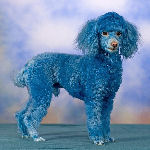
When the actress opened the door to the bedroom, Suzette, whose fur was tinted light blue to match her surroundings, got out of her baby blue canopy dog bed and ran to her owner.
"There's my little sweetums," the actress said, hugging the dog and kissing its snout.
"You dyed your dog's hair blue?" the photographer from Redbook asked with disbelief. "Isn't that inhumane?"
Roxie was generally taken aback by the man's question.
"I would never do anything to hurt my dog! Suzette is my baby."
Her tail rapidly wagging from side to side, the poodle licked her owner's face and stared up at Roxie with obvious adoration.
After an hour-long tour of the house, the journalists and photographers were treated to a magnificent hot and cold buffet and open bar. While not one of the people from the magazines considered the house anything but a gaudy eyesore, every one of them covered it in his or her respective publication. While most limited their coverage to a few paragraphs and one or two accompanying pictures, others devoted full-color, multi-page spreads to the Sutters' baby blue home.
* * *
Although Roxie Gerow had become a staple of movie magazines and supermarket tabloids, her career was still stagnant. After her role in the horror movie, she starred in only three subsequent pictures—all foreign "art" films.
"It's just not fair!" she cried to her husband after returning from shooting her latest movie in Italy. "Did you see the Academy released this year's nominations today?"
"No, I didn't," Judson said, not even bothering to feign interest.
Over the five years they were married, the former football player had steadily lost interest in his high-maintenance wife.
"Glenda Jackson is on the list of nominees again—surprise, surprise. That makes three times in four years. Then there's Ellen Burstyn who was nominated for supporting actress two years ago. Let's not forget Barbra Streisand, who already won an Oscar for Funny Girl. And Joanne Woodward, this is her third time. Worst of all, Tatum O'Neal and Linda Blair are nominated for supporting roles. They're just kids, for Chrissake!"
"Awh, stop your bitchin' already!" Judson cried, unable to stand his wife's whining any longer.
"What did you say to me?" Roxie asked, stunned at his angry outburst.
"You heard me. I'm tired of hearing you complain about your career. Face it: you're never going to be nominated for an Oscar. You'll never even get a role in a nominated movie."
Furious, the actress pulled back her hand and slapped her husband across the face, leaving a red handprint on his cheek. Judson didn't hit back; he didn't need to. His words would hurt more than any physical blow.
"You're not that good of an actress. You're nothing but a joke, the baby blue freak of the week. A scantily clad body without talent."
"And what about you?" Roxie retaliated. "A washed-up football player trying to hold on to his glory days."
"At least I was something once. I was a two-time MVP winner who appeared in four Super Bowls. You know what they say: I'd rather be a has-been than a never-was."
It was the couple's first real argument—and their last. Judson refused to apologize, and even if he had, his wife would not have forgiven him.
A week after the quarrel Roxie Gerow filed for divorce, demanding not only the house and everything inside it but a full half of Judson Sutter's considerable fortune as well.
* * *
"Mommy has a present for you," the actress said, putting a new blue collar on her dog. "This one is even nicer than your old one. It has sapphires in it instead of rhinestones."
Suzette danced on her back paws, twirling around like a ballerina.
"My little sweetheart!"
Roxie had always been an animal lover even as a child, but the toy French poodle was literally the love of her life. In fact, the adorable little dog meant more to her than any human ever had—including her soon-to-be ex-husband, Judson Sutter.
Usually a quiet, well-behaved animal, Suzette woke the neighbors early one morning with a shrill and persistent barking.
"What's got into that dog?" Velma Moseley, the elderly woman who lived across the street from the baby blue mansion, asked her husband, Tex, a former MGM cowboy star.
"I don't know, but I wish it would stop that infernal yapping."
Half an hour passed, and the dog's barking became a mournful howl.
"You don't think the dog's hurt, do you, Tex?"
"I don't know. Why don't you phone Roxie and see if there's something wrong?"
The old woman dialed her neighbor's number, but the actress didn't answer.
"Maybe she's not home," Velma concluded.
"Her car's there," Tex observed. "No one else drives a baby blue Ferrari."
"Maybe I ought to run across the street and check on her."
"No," her husband said. "I'll go."
He returned home shortly with the terrible news: Roxie Gerow had been murdered, stabbed at least a dozen times.
* * *
As was usually the case when a woman is murdered, the police considered the husband, Judson Sutter, a person of interest in his estranged wife's death.
"I didn't kill her," Judson insisted. "I was in New York meeting with people from ABC Sports about a possible broadcasting job."
Although the former football star's alibi checked out, chief investigator Darrell Sholes was not about to cross him off the list of suspects.
"He's got millions," the detective said. "He wouldn't be the first husband to pay someone to bump off his wife."
"But Sutter's a football hero," Sonny Mancuso, his partner, argued, coming to the athlete's defense. "He wouldn't kill anybody."
"That remains to be seen. Let's go talk to the neighbor who reported the death."
Velma Moseley invited the two detectives inside her house and offered them coffee and homemade cookies.
"I just baked them this morning, Detective," she told Sonny, who admitted he had a fondness for snickerdoodles.
"Mrs. Moseley, did you see or hear anything out of the ordinary the night your neighbor was murdered?" Darrell asked as his partner dipped a cookie in his coffee.
"About four in the morning, my husband and I were woken by the dog barking."
"That would be Miss Gerow's dog?"
"Yes. She had the cutest little dog. A French poodle. She dyed its fur blue."
"A blue dog?"
"I don't mean to speak ill of the dead," the old woman said in a conspiratorial tone, "but Roxie Gerow was willing to do anything to get her name or her picture in the papers or the magazines. That's why she built that big house and painted everything inside and out baby blue. The dog, too."
"Someone ought to have reported her to the ASPCA," Sonny observed, after finishing his third snickerdoodle.
"Oh, no! It was just a harmless dye like the kind people use to color Easter eggs. Roxie would have cut off her hand before hurting Suzette. She doted on that dog! Why, she would feed it filet mignon instead of Alpo. And she even bought it a blue collar decorated with real sapphires."
"Getting back to the night of the murder," Darrell said. "You and your husband were woken up at about four in the morning."
"That's right. I looked at the bedside clock, and it read 3:48."
"Was the dog in the habit of barking at night?"
"Oh, no. It was always such a quiet little dog. It hardly ever made a sound. That's why I was so concerned. At first, I thought maybe Suzette had seen a cat or a raccoon, but she kept on barking. Then she started to cry as though she'd been injured. I phoned Roxie, but there was no answer. That was when Tex—that's my husband—went across the street to see what was wrong."
"We'd like to speak to your husband. Is he at home?"
"No, he and his brother are playing golf, but he'll be back later this afternoon."
"We'll come back then," Darrell announced, closing his notebook as his partner took one last cookie.
* * *
Two days later, Roxie Gerow was laid to rest after a funeral that drew hundreds of curious spectators. Since none of the wounds had been above her neck, she was put on display in an open baby blue casket. Her famous bleached blond locks were arranged in an elaborate coiffure designed to showcase a diamond and sapphire tiara that matched the necklace, bracelet and ring she wore. She was dressed in a sequined velvet gown, also baby blue in color.
Siegfried Ernst, Roxie's manager, told the detectives the jewelry and tiara had been rented for the occasion and would be returned to the jeweler before the burial.
Detectives Sholes and Mancuso followed the funeral procession to the Hollywood Cemetery, observing the actions and expressions on the faces of those present. Surprisingly, Judson Sutter seemed genuinely grieved over the actress's death.
"That man's a better actor than his wife was," Darrell whispered to his partner.
"I tell you he had nothing to do with it," Sonny quietly argued. "Sutter is a hero to millions of kids around the country."
"He's a rich man who was facing a messy and costly divorce with a wife who wanted to get as much out of him as possible."
"Can you blame him for not wanting to give her his hard-earned money? Look at what she spent on that house! A mink bedspread, a heart-shaped swimming pool—and a sapphire dog collar for her blue French poodle. And I was mad as hell when my wife bought a cashmere sweater."
"The difference is you don't have the money," Darrell pointed out. "Sutter does."
As the detective watched the former football player place a single long-stemmed red rose on his late wife's casket, he felt something soft rub against his leg. He looked down and saw Roxie Gerow's dog, Suzette.
"How did she get here?" he asked his partner, as he bent down to pet the animal. "I thought one of the patrolmen took her to the animal shelter."
"He did. Are you sure that's the same dog?" Sonny asked.
"How many blue French poodles do you think there are?"
The dog looked up at the detective and made a mournful whine.
"What's the matter, girl? Do you miss your owner?"
"Too bad dogs can't talk," Sonny said. "I'll bet if this one could, she'd be able to tell us who the killer is."
Darrell picked up the poodle and carried it over to Judson Sutter, who was heading back to the funeral car. The widower was surprised to see the animal.
"What's Suzette doing here?" he asked.
"She just showed up. I don't suppose you want to take her home with you?"
The former athlete reached out his hand and petted the dog's head. Darrell was surprised and admittedly disappointed when the poodle licked Sutter's hand.
"Under other circumstances, I would," the widower answered. "She's a good little dog. But I've decided to take that job with ABC. I'll be traveling all around the country, covering the games. I just won't be able to take care of a dog."
"Don't worry about it. I'll see that she gets a good home," the detective promised.
* * *
Three months after Roxie Gerow was consigned to the grave, Detective Sholes was at home having breakfast, reading the sports section of the daily newspaper as his wife, June, thumbed through People magazine.
"Did you see this?" she asked.
"See what?"
"Judson Sutter got remarried."
Darrell put down his paper and reached for the magazine. According to the article, the middle-aged, former football hero turned television sports broadcaster had married a twenty-three-year-old redhead who had recently finished second runner-up in the Miss America Pageant.
"Well, I'll be damned! His first wife isn't even cold yet, and the no-good bastard has already got himself a trophy wife."
"Aren't you being a bit hard on him?"
"Hard? He got away with murder!"
"You don't know that," June argued.
"My instincts and years of experience on the force tell me he did."
"But wasn't he in New York at the time Roxie Gerow was murdered?"
"Just because he hired someone else to do his dirty work doesn't make him any less guilty in the eyes of the law."
Wanting to read the story in its entirety, Darrell turned to page thirty-one where the article continued, but he was distracted by the photograph that appeared on page thirty.
"How the hell ...?"
"What is it?" his wife asked.
"It's Suzette," he replied.
"Who's that?"
"Roxie Gerow's dog."
The article on page thirty described how, despite the best efforts of the caretaker to keep her out, a blue French poodle repeatedly found its way into the cemetery to maintain a silent vigil at the slain movie star's grave.
"I took her to the animal shelter myself after Roxie's funeral. The administrator later told me a couple from Seattle adopted her."
"Are you sure it's the same dog?"
"As I once asked Sonny, how many blue French poodles do you think there are?"
* * *
Although Detective Sholes never gave up hope of someday putting Judson Sutter behind bars for the death of his wife, twenty years went by and the Roxie Gerow murder remained unsolved. Although he no longer actively worked the case, Darrell kept the file in his desk drawer and periodically reread the case notes, hoping to find something he had overlooked.
Then one morning Sonny Mancuso walked into the station with a forlorn look on his face.
"What's wrong?" his partner asked.
"Didn't you hear the news on the radio this morning?"
"No, I was listening to a Fleetwood Mac CD on my stereo."
"Judson Sutter dropped dead while he was out jogging."
Darrell took the athlete's death hard, not because he felt any sense of loss but because he believed the football player had escaped justice.
"Now what are we going to do?" Sonny inquired.
"About what?" asked his confused partner.
"We should have both retired five years ago, but you kept putting it off, saying you'd leave after we solved Roxie Gerow's homicide."
"I don't know," Darrell replied honestly. "We didn't really solve anything, did we?"
"I, for one, am ready to hang up my gun and badge and let the next generation serve and protect the citizens of this city."
"I don't know. It just feels like we're leaving something undone."
"Would that be so horrible? No one's found Zodiac yet or the person who killed William Desmond Taylor. And how long has the Black Dahlia case remained open?"
"I suppose you're right, but I don't know if I want to retire yet. That shouldn't stop you, though."
"You know me, Darrell. I've had three failed marriages and no children to show for them. Ours is the only close relationship I have in my life. We went through the academy together, joined the force at the same time and made detective on the same day. You're the only partner I've ever had. I'll stay as long as you do. And don't think for one minute you're going to get rid of me when we do retire! I expect us to go fishing at least once a month and catch a few ball games during the year."
"I'll think about it, talk it over with June and let you know."
* * *
Surprisingly, Judson Sutter was laid to rest beside his first wife. Unbeknownst to the mourners, Tanya Sutter, the still-attractive widow, only chose to bury her husband in that plot because it involved no cost or inconvenience to her.
Again, hundreds of people gathered at the cemetery to pay their final respects. Although he had no official reason for being there, Detective Sholes was in attendance.
You got away with it, Darrell thought, staring at the enlarged photograph of the deceased that was on display beside the casket. If only ....
Darrell felt a strong sensation of déjà vu as something brushed against his leg. He looked down and was astonished to see a blue French poodle looking up at him, wagging its tail.
"Suzette!"
No, he realized. It can't possibly be her. No dog lives that long. Someone else must have gotten the idea from Roxie Gerow to dye a dog blue.
The detective reached down, and the poodle licked his hand. However, when he tried to pick up the dog, she pulled away from him. She ran over to the widow, sat down in front of Tanya and started barking and growling.
"Somebody get that damned animal out of here!" Tanya shouted angrily.
Darrell stepped forward to retrieve the dog, but she ran off before he could catch her.
"I hope it runs in front of a car," the widow cried. "I hate dogs!"
The detective sensed something was not right. The poodle seemed to be friendly enough. Then why had its behavior toward Mrs. Sutter been so threatening? Could it be because the animal instinctively knew the woman hated dogs, or was there another reason it singled her out in the crowd?
* * *
Although Sonny continued to bring up the subject of retirement on a regular basis, Darrell had yet to make a decision.
"I'm still thinking about it," Sholes repeatedly told his partner.
"All right, but need I remind you that we're not getting any younger?"
"Then while we still have our wits about us, why don't we go have a talk with Tanya Sutter? I have a few questions I'd like to ask her."
After interviewing several of Judson Sutter's old friends and business associates, Darrell and Sonny discovered that the athlete was seeing Tanya well before his wife was murdered and that the two had begun having an affair while Roxie was in Italy filming her last movie.
"I gotta hand it to you, Detective," the widow said to Sholes when he and Mancuso showed up at her house unannounced. "You're like a dog with a bone. You never give up. Even if Judson did kill his first wife, like you seem so sure he did, what can you do about it? Dig him up and charge his corpse with homicide?"
There was an enigmatic smile on Darrell's face as he responded, "Humor me, won't you? I just want to tie up some loose ends."
Anxious to put the whole sordid mess behind her, Tanya reluctantly invited the two detectives inside.
"Now what do you want to know?" she asked haughtily.
"We have proof your husband was in New York when Roxie Gerow was murdered. What I'd like to know is where you were."
Although she quickly covered the shocked expression his question had elicited, Tanya could not hide the sudden paleness of her complexion.
"I ... I was on a modeling assignment."
"At four in the morning?"
"It got over late, sometime after midnight, if I remember correctly, and then I went home to bed. I slept straight through until ...."
The sound of a dog barking outside her living room window startled her.
"Why can't people keep their damned dogs inside?"
The barking abruptly stopped, but it was soon replaced with a high-pitched whining and scratching sound at the front door. The detective opened it and saw a familiar blue French poodle on the stoop. The animal wagged its tail and headed toward the side of the house, momentarily stopping to see if anyone was following.
"Let's go see what the dog wants," Darrell said to his partner.
The three people followed the animal around the side and into the backyard. The poodle then ran to the door of a small shed beside the garden and once again began to howl.
"You can't go in there," Tanya cried. "Not without a warrant."
Darrell turned to Sonny and said, "You go get a warrant. I'll wait here and make sure no one enters that shed while you're gone."
Tanya closed her eyes, and tears fell down her cheeks. She had been defeated, and she knew it.
"Go ahead and open it," she said. "You'll find what you're looking for on the top shelf, behind the cracked lawn gnome."
Moments later Darrell came out of the shed, gingerly holding a knife. Although the weapon had been wiped clean, the detective had little doubt that when sprayed with luminal, it would reveal trace amounts of Roxie Gerow's blood.
"We'll have this checked for fingerprints," he announced.
Darrell, elated at finally having the proof that would solve the twenty-year-old homicide, was taken aback by what the widow said next.
"Who can I talk to about making a plea deal?"
The detectives were so surprised by what amounted to an admittance of guilt that neither noticed the poodle had vanished.
* * *
The day after Tanya Sutter signed a formal confession, attesting to the fact that she alone had murdered Roxie Gerow without the aid or knowledge of her late husband, Detectives Sholes and Mancuso formally announced their retirement.
"Congratulations!" Sonny said, shaking his partner's hand. "You did what you said you were going to do. Now you can retire without an unsolved case hanging over your head."
There was a look of sadness rather than triumph in Darrell's eyes.
"I'm not retiring because the case is finally closed. I'm retiring because I realize I've been wrong all these years. I was so certain Judson Sutter was behind his wife's murder that I never really looked in any other direction. I wonder if that's why so many cases go cold in this country because cops like me get tunnel vision."
"Don't go beating yourself up," Sonny said sympathetically. "You were a good cop, and in the end, you did bring Roxie Gerow's killer to justice."
Did I? Darrell wondered. Would I have solved the case without the help of that dog?
* * *
After pleading guilty to second-degree murder, Tanya Sutter was sentenced to fifteen years to life. At the conclusion of the sentencing hearing, Darrell and June Sholes, who had been spectators in the courtroom, drove home past the cemetery where the murdered actress was buried.
"I want to stop for a moment," the retired detective announced.
His wife had no objection. The two of them got out of the car and headed in the direction of the Sutters' double burial plot.
"What's that on the grave?" June asked as they approached the site.
"Bones," Darrell replied when he drew nearer. "They look like canine bones."
June noticed something glinting in the afternoon sun. She leaned forward and picked it up.
"It's a dog collar," she said. "A light blue one with blue stones in it."
"It must have belonged to this dead dog," her husband concluded.
"I doubt it. The collar looks new whereas those bones look like they've been here for years."
"They couldn't have been. This is one of the best-kept cemeteries in Hollywood. The caretaker would have found them and removed them."
"Wait a minute," June said. "There's a small, heart-shaped name tag on this collar."
"What does it say?"
"I can barely make it out, but I think it says ... Suzette."
To his wife's great surprise, Darrell took off his jacket, knelt down and began digging in the ground above Roxie Gerow's grave with his bare hands.
"What do you think you're doing?"
The former detective didn't reply. He simply dug a hole, put the bones and collar inside it and then covered them up with the loose soil. After brushing the dirt off his hands and retrieving his jacket from the top of the headstone, he finally spoke.
"That little blue poodle has been a faithful companion all these years. I think she deserves to rest with her owner."
This story was inspired by my recent vacation to the United Kingdom where I saw the Greyfriars Bobby statue in Edinburgh and Glasnevin Cemetery in Dublin.
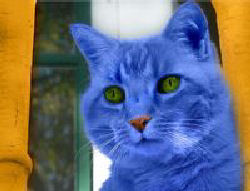
Salem once dyed his fur blue, but the color clashed with his green eyes, so he went back to black.


