The Key to Happiness
The citizens of Coventry Hills awoke to a warm, sunny day. At first, no one noticed anything unusual about that daybreak. The baker rose early and headed to his shop, where he began making bread. The blacksmith lit the fire in his furnace, and farmers went to their barns to milk cows and feed chickens.
Life in the small New England village had changed very little in the more than three hundred years since the town was founded. This was partly due to the towering mountains that surrounded Coventry Hills and the steep, treacherous mountain paths. Few people ventured in, and even fewer ever left. Consequently, because of the town's inaccessibility, its citizens had not been greatly affected by outside influences.
As the morning sun filtered through her bedroom window, Harmony Griggs woke from her sleep. Her husband, Quincy, was already up. Quincy Griggs was a tailor. He and the couple's son, Linus, made most of the clothing worn by the villagers. Hester Potts; the seamstress made the rest. No one went to the stores beyond the mountains to buy manufactured goods.
After getting out of bed, the first thing Harmony noticed was a definite chill in the air. The temperature felt much colder than the usual seventy degrees. She suppressed a shiver and walked out into the kitchen, where she saw Quincy sitting at the table, staring out the window.
"What's wrong?" she asked. "Why aren't you out in your shop finishing up George Miller's new britches?"
"I have an ache in my arm."
Bewildered by her husband's claim, Harmony sat down in the chair across the table from him.
"And I felt a chill in the air when I got out of bed."
The two people looked at each other, unable to comprehend why things should suddenly be so different.
* * *
Before the sun climbed to its overhead position in the noon sky, the people in nearly every house and shop in Coventry Hills stopped to seriously ponder problems that would seem minor and mundane to those of us living beyond the mountains. The baker, for instance, was amazed to see that the bread he had baked the day before had become hard overnight. Farmer Williams was stupefied when he saw that the stalks of corn in his field had started to wilt. Mrs. Travers, the minister's wife, burst into tears when she saw several strands of gray in her auburn hair. Only the children were immune to this sudden introspection. They continued to laugh and play, oblivious to the subtle changes that were occurring around them.
One by one, the adults, young and old, left their homes and wandered toward the town common. Craftsmen left their shops and joined their neighbors, followed shortly by the farmers as they deserted their fields. No one laughed when Mr. Graves appeared in his underwear because his pants were suddenly too tight or when Mrs. Revere fainted at the sight of a dead bird in her front yard. On the contrary, most of the townspeople walked about the common in dazed silence.
It is uncertain how long the good citizens of Coventry Hills would have stayed outside, aimlessly loitering around the common like a convention of zombies, had not the weather abruptly and drastically changed. Dark clouds blew in from the east and blocked out the sun. Only when lightning ripped through the sky and thunder echoed against the mountains did the townspeople regain their senses and run for cover.
"It's raining!" Harmony exclaimed in awe.
"It's been so long," her husband commented. "I forgot what it was like."
The storm eventually passed, and the sun returned, but the rain had left puddles, wet grass and mud in its wake. Once again, the people ventured out of their homes, only now their confusion and lethargy gave way to fear.
What is happening?
It was the question on everyone's mind and lips. Like many people in times of crisis, the adults of Coventry Hills turned to the town minister, their spiritual leader, for guidance.
"I'm sorry that I don't have any answers for you," Father Micah Travers apologized. "I have no idea what's happening here. All I can suggest is that you pray and then return to your homes, your shops and your fields and try to go about your business as if nothing has changed."
Most people found the minister's advice to be sound, but others—the ones with good memories—were still alarmed.
"I remember the way things were before," Harmony confided in her husband as they walked back to their house. "Most things anyway."
"I think I've forgotten more than I recall. But I do remember my mother and father."
Harmony put her hand on her husband's arm, knowing the physical contact would give him comfort.
"I can't imagine what it's like to lose someone you love," she declared, grateful that both her parents were still alive.
"We have to find out what's wrong or else you may very well learn how it feels."
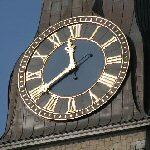
Directly across the common from the church stood the town hall, an impressive brick building with a clock tower that stood a good six feet higher than the church steeple. No one bothered to look at the clock; few people in Coventry Hills cared to know the exact time of day.
So, when Peter Jacobs yelled out, "The clock's not working," no one was particularly alarmed.
* * *
The townspeople persevered and got through the day despite what to them were minor catastrophes in their lives. When they awoke the following morning, they discovered their prayers had not been answered and that their perfectly ordered lives continued to disintegrate. There were more gray hairs, more wrinkles, and more aches and pains. Both men and women were walking a little slower, breathing a little heavier, having some difficulty seeing or hearing and feeling decidedly older.
"If this keeps up," the baker predicted, "we'll all be ...."
Shouts of denial erupted in the crowd of townspeople who once again congregated at the town common.
"If Father Travers can't help us," the blacksmith advised, "why don't we ask Theophilus Pitt?"
The people exchanged hopeful glances.
"Theophilus Pitt! Of course," they all agreed.
There was a time when Pitt was the mayor of Coventry Hills, many years ago, when there was still a need for some form of government.
"We can't all go up to his house at once," the cooper cautioned. "Why don't three of us go and talk to him, while the rest wait here?"
"I'll go," Quincy Griggs offered.
"Me, too," the baker seconded.
Father Travers made the third man.
Former Mayor Pitt, who lived in a large house on a steep hill overlooking the town, was the oldest person in Coventry Hills. His advanced age was the reason he was unable to join the other townspeople on the common. Getting there wouldn't have been too difficult, but going back home was another matter. Theophilus, however, had been watching the town from his window and had been waiting for the three men when they arrived at his house.
"I know why you're here," he admitted after cordially inviting them inside and offering them refreshments. "It's about the storm."
"That's not all," Father Travers informed him. "People are complaining of stiff muscles, failing eyesight ...."
"We're growing older," Quincy interrupted, immediately getting to the point.
"Oh, dear!" Pitt moaned. "The clock has stopped, hasn't it?"
"Yes," the baker replied, "but what difference does that make? No one really cares about measuring the passage of time—not here in Coventry Hills."
"Someone has stopped the clock," Pitt deduced, his voice conveying a mixture of fear and authority. "We need to find the key and wind it up again."
The three men looked at each other, wondering if Theophilus had lost his mind. Who cared about a useless clock at such a time?
"You don't understand," Pitt stressed, hoping to spur the delegation into action. "We have to find that key!"
"Why?" Father Travers wondered.
"That clock is the secret of our happiness. It is what keeps our town safe from harm, what enables us to live our peaceful, idyllic existence."
"How? It's just a clock."
"No. It's magic—pure and simple magic."
Quincy shook his head. He, for one, did not believe in magic.
"Try to remember. Father, surely you must recollect what it was like just before it happened."
The minister's face clouded.
"There was talk of a war," he recalled, his mind straining to remember. "A rebellion of some sort against the Crown, I believe."
"Yes," the baker concurred, "I remember hearing about that many, many years ago."
"Wait!" Pitt cried as a long-forgotten vision surfaced. "When my memory started to fail, I wrote it all down."
He walked into his study and searched his bookshelves.
"Now, where did I put that? Ah! Here it is."
Pitt took down a leather-bound journal, its pages yellowed and brittle with age.
"Listen to this: 'We received word today that representatives from all thirteen colonies met in the city of Philadelphia in the Colony of Pennsylvania. These men decided that the American colonies would forevermore be independent and free from British rule.'"
"What has this talk of independence and British rule to do with us?" Quincy demanded to know. "We here in Coventry Hills have naught to do with world affairs."
"That's true now, but at that time the war with England was getting dangerously close to our borders."
Theophilus searched his journal for the appropriate entry, which he then read aloud.
"'Into Coventry Hills came a wounded man, a foreigner to our shores. He told us, in his limited command of English, that he was from Germany and that he had been abducted and forced to join an army of mercenaries under penalty of death. These soldiers, called Hessians, were then enlisted by the British King to help quell the rebellion in the colonies.'"
"I vaguely remember a man with a strange accent," Quincy muttered.
"That was him, Franz Schenck. He had deserted from the army, and in his flight into the mountains, he stumbled upon our village."
"What happened to him?" the baker argued.
"He begged us for asylum. What could we do? We nursed him back to health and let him stay here. He lived among us for many years and even married a local girl—one of the Putnams, I believe. Eventually, he became ill. Before he died, he wanted to show his gratitude for all that the people of Coventry Hills had done for him."
The three visitors waited expectantly for their host to conclude his story.
"Franz Schenck had been a clockmaker in Germany, a gifted artisan. He made the clock in the town hall. When it was completed, he took a knife, sliced open the palm of his hand and used his blood to grease its gears."
"What madness!" the minister screamed.
"He gave me the key for safekeeping, and then he and his wife—who loved him dearly and couldn't bear to live without him—gave their lives in exchange for the magic of the clock."
Quincy was losing his patience.
"We're wasting time with all this talk about magic. We have to find out why, all of a sudden, things are going wrong around here."
"That's what I've been trying to tell you," Pitt said with exasperation. "It was the clock that kept our weather perfect and maintained the crops in the fields. It was the reason why we all stayed healthy, and as long as that clock kept ticking, we didn't age. You and I and everyone in Coventry Hills are just the same as we were in 1780, more than two hundred years ago by my calculations."
"How can this be true?" the minister asked. "Surely it was God, not some German clockmaker, who so blessed us."
"Think about your parents and your grandparents. They all grew old and died, but that was before the clock was erected. Since the day Franz wound it up, no one has grown old, gotten sick or died. Have they?"
The three men shook their heads. What the former mayor said was true. It was not a mere coincidence that people were beginning to feel the minor aches and pains that went along with age, that the crops were starting to wilt in the fields or that a severe thunderstorm broke a more than two-hundred-year-old record of perfect, sunny weather, all at the same time that the clock on the town hall stopped ticking.
"What can we do to make things right again?" Quincy desperately questioned Pitt.
"We have to wind the clock."
"And pray to God that everything will return to normal," the minister added.
"Well, go get the key, and we'll find out," the baker instructed the former mayor.
Theophilus wrung his hands nervously.
"Yes, quite right. The problem is I can't seem to remember where the key is."
* * *
The church bells pealed loudly. Everyone in Coventry Hills ran to the common and stared up at the belfry in the church steeple. The bell had not been rung in many years. When everyone was present, Father Travers addressed his flock.
He briefly told them of the miracle wrought by the Hessian clockmaker and ended his speech with the warning, "If we don't find that key, we'll ...."
The minister's last words were drowned out as men and women in the crowd shouted out their eagerness to help with the search. The townspeople were divided into two groups: the first would search the town hall, and the second would search Theophilus Pitt's house.
One day passed, then two. Both buildings had been nearly torn to pieces by the searchers who were frantic to restore the Utopian existence of Coventry Hills. By the end of the third day, they had run out of places to look.
"Think, damn it!" the blacksmith urged Pitt. "You must remember where you put the key."
The old man put his head in his hands and sobbed, "I can't."
Most of the people of Coventry Hills were on the verge of panic. They were suffering not only from real aches and pains but also from imaginary ailments. On several occasions, the heightened emotions nearly resulted in an outbreak of violence.
"We cannot waste our time with this foolish bickering," Father Travers scolded two men who were about to have a fistfight. "We must concentrate on finding that key."
"But where should we look now? We've searched every inch of the town hall and Pitt's house."
"Perhaps he buried it in his yard," Quincy theorized. "Let's go get some shovels and start digging."
* * *
Linus Griggs and his friends met at the swimming pond in back of Farmer Williams's field. The dozen or so youngsters, who ranged in age from nine to fifteen, were alarmed by the discord that raged through their heretofore peaceful town.
"We've got to tell them," Patience March said guiltily.
Linus disagreed. The other adolescents were uncertain; only Linus was resolute.
"We can't tell them," he insisted. "They'll make us give it back."
Thomas Bishop, the oldest and strongest of the group, stepped toward Linus menacingly.
"Patience is right. We've got to tell the truth."
Linus reluctantly relented, and the group of youngsters walked into town. They went directly to the church where Thomas rang the bell. The townspeople again rushed to the common.
Did someone find the key? they all wondered hopefully.
When Harmony and Quincy Griggs saw their son and his friends standing on the top step of the church, they stopped short.
"Linus, what are you doing here?" the father asked.
"Tell them," Thomas Bishop ordered the younger boy.
Linus hung his head and sulked.
"I found the key," he mumbled.
"Praise God!" Father Travers cried, still attributing the miracle to the Almighty rather than to a Hessian soldier.
"Give it to me, son," Quincy commanded, not bothering to ask where the boy had found it.
The questions could wait; of utmost importance was winding the clock.
"No," Linus responded, raising his head defiantly. "You can't start the clock again."
A sharp intake of breath was heard in unison throughout the crowd.
"We have to wind it," Quincy said urgently. "It's a matter of life and death."
"That's right. But not just for you and Mom and the rest of the adults. It's a matter of life and death for us, too," his son contended, indicating his group of young friends. "How dare you condemn us to eternal childhood?"
Quincy was taken aback by his son's outburst.
"I don't want to be thirteen forever."
"Why in God's name not?" Father Travers asked.
Harmony pointed out gently, "You're a child; you have no idea what it means to get sick, to grow old and die or to lose someone you love."
"No, and if you wind the clock, you will be denying us the very love you and Father cherish so much. I want to be a man someday," Linus protested, glancing at Patience March and blushing. "I want to marry and have children of my own. But I can't. None of us can if you wind the clock."
The parents in the crowd looked uncomfortable. Were they being selfish? Was it fair to deny their children the right to mature and lead a normal life?
"I found the key last week," Linus confessed. "It was under a loose rock in the wall that encircles Mr. Pitt's property."
"So that's where it was," the former mayor uttered with a sigh of relief.
"There was a note wrapped around the key, explaining what would happen if the clock should stop ticking. I showed the note and key to my friends, and we voted to stop the clock."
The townspeople were silent. For so long, their lives had run smoothly, without so much as a ripple in the flow of their daily routines. Now, for the first time in over two hundred years, they had to make a decision that might have dire consequences.
Theophilus Pitt, settling into his old role as the town's leader, stepped forward.
"Gentlemen," he announced with authority, "let us go into the town hall and discuss this matter further. Then, after a debate, we can take a vote on how to proceed."
"Don't we women have any say?" Harmony called out.
Women having a voice in government? That was unheard of, but it did seem logical. After all, women would be affected every bit as much as men by the decisions that would be made.
"And the children," Father Travers stipulated, putting his hand on Linus's shoulder. "Their lives will be impacted most of all by our vote. Let them voice their opinions, too."
* * *
The decision was almost unanimous. While the townspeople had hitherto enjoyed and were greatly appreciative of Franz Schenck's gift, it was decided not to wind the clock.
"Let nature take its course," Quincy Griggs said.
"You mean we should let God's will be done," Father Travers contradicted him with a smile.
Thus, the people of Coventry Hills voluntarily walked out of Eden. They gave up eternal life, excellent health and perpetual sunshine. In exchange, they gained something far greater. They discovered in only a few days what it had taken some societies many generations to learn. It is a lesson that, sadly, some people to this day have yet to comprehend. Every man, woman and child in Coventry Hills had been given the right of choice. They learned to accept—even though they did not always agree with—the opinions and wishes of others. And although the people of Coventry Hills began to grow old, get sick and die, they did so with dignity and grace.
Perhaps, thought Father Micah Travers in a moment of introspection, that is the true key to happiness, the real gift the grateful Hessian soldier bestowed upon the people of Coventry Hills.
Salem gave me this magic clock to remind me when it was time to feed him: every hour on the hour!


