A Perfect Gentleman
Dr. Edgar Prescott Bidwell was a true Victorian gentleman, the epitome of nineteenth-century decorum, morality and propriety. Born in Boston, Massachusetts in November 1862, after an uneventful childhood, Edgar grew to be a quiet, soft-spoken unassuming young man whose appearance was often charitably described as "plain" or sometimes, less kindly, as "mousy" or "homely."
Lacking an active social life, he devoted his time to his studies. While attending medical school, he had the opportunity to travel to Europe to observe the latest surgical techniques. It was during his sojourn in London that young Bidwell walked down the elegant streets of the wealthier neighborhoods, admiring the homes of the upper-class English gentlemen. Upon seeing these grand townhouses, Bidwell swore an oath that should good fortune ever come his way he would own such a home.
At twenty-six years old, Bidwell married a young woman with neither wealth nor beauty. It was a marriage of convenience, not of love. In those days a young woman needed a husband to provide her with the necessities of life such as shelter, clothing and food, and a man needed a wife to handle the domestic and social burdens of his life. There was often no passion in such marriages, so it was not unusual that there was little physical contact between Mr. and Mrs. Bidwell.
During one of their rare sexual interludes, however, a child was conceived. Sadly, fatherhood held no more joy for Edgar than marriage did. It was simply a fact of life: you were born, you married, you reproduced and you died. As far as the hard-working medical student was concerned, feelings of love and affection had little to do with the human condition. Even when his young wife died of pneumonia, leaving him a widower at twenty-nine, Bidwell felt no strong emotion, not grief or anger or even disappointment. He simply sent his young son to live with his in-laws and continued with his studies.
When Edgar finished medical school and started practicing medicine, he rented a one-bedroom flat in a Beacon Hill townhouse. The rent was somewhat expensive for so small an apartment, but Bidwell reasoned that the Beacon Hill section of Boston was as close as he would ever get to the gracious homes of London.
* * *
Shortly after his thirtieth birthday, Dr. Bidwell acquired a new patient: Belle Brown, a nineteen-year-old matron interested in pursuing a career on the musical stage. Belle was not beautiful or even attractive, but she did have a full figure. This asset was all the more noticeable since she wore tight-fitting corsets and low-cut bodices. There was nothing at all modest about Belle Brown. Bedecked in brightly colored clothes and gaudy costume jewelry, she spoke and acted more like a Boston fishwife than a proper young Victorian lady.
Mrs. Brown first consulted Dr. Bidwell, hoping to find relief for a throat made sore by hours of singing. After their initial meeting in his office, Edgar was quite surprised to run into her one night while he was dining alone in a restaurant on Boylston Street. He had just ordered his dinner when he heard her voice call out, "Well, if it ain't Dr. Bidwell!"
Mrs. Brown was dressed in a scarlet gown, adorned with white and black lace, cinched at the waist and low at the neckline. Atop her head was an enormous hat, covered in yards of lace, ribbons and scarlet roses. Bidwell was frankly surprised that Belle's delicate neck did not snap under the bonnet's weight.
"Good evening, Mrs. Brown. Are you and Mr. Brown dining here tonight?"
Not one to wait for an invitation, Belle pulled out the chair next to him and sat down.
"No need to be so formal, Doctor; just call me Belle."
She leaned forward and Edgar had a delightful view of her impressive cleavage.
"It's not likely my husband will be joining me tonight. He's out with his fancy woman."
Bidwell was shocked by her revelation. People did not discuss such matters with casual acquaintances. The doctor was flustered, uncertain as to how he should respond to such a coarse woman. Yet despite her apparent lack of good breeding, the aspiring singer was a fascinating dinner companion, and Bidwell found himself attracted to her.
When the meal was over, Belle suggested the two of them go to a dance hall to hear one of her friends perform. The establishment was crowded, and the young doctor frequently found himself pushed up against the buxom Mrs. Brown. Although he had never been particularly interested in sex, he was only human and found such close proximity to so voluptuous a woman exquisitely tantalizing.
At the end of the evening, Bidwell walked his young patient home. Belle lived in a small rented room in a respectable but less-than-affluent neighborhood. He stood outside her door and attempted to say goodnight.
"I've had a wonderful evening, Mrs. Brown," he announced formally.
"I told you to call me Belle," she said, laughing. "I have a small confession to make, Doctor. I ain't really married. Mr. Brown ain't my husband. He's just a good friend who is kind enough to share his lodgings with me until I can find a job and a place of my own. We told the landlady we was married so's we could avoid a scandal."
"There's no need for you to explain your domestic situation to me, Mrs. ... uh ... Belle," he replied, more than a bit embarrassed by her candor.
"I wanted you to know the truth before I invited you inside," she admitted.
"Won't your friend, Mr. Brown, object?"
"Him? Nah! He packed up and left more than a week ago."
Belle opened the door, and the two of them stepped inside a room that was hardly larger than a foyer. The wallpaper was peeling, and the paint was chipped. There were four pieces of well-worn furniture in the room: a bed, a chair, a small table and a trunk. The place was a mess. Dirty dishes and women's clothing and undergarments were strewn about the room. Belle picked a petticoat up off the bed with no sign of embarrassment.
"Why don't you have a seat?" she said, patting the bare mattress.
When Belle bent over, Bidwell once again had a view of the top of her generous bosom. In an impulsive, uncharacteristic reaction to her charms, he reached out for her, and as they kissed, Bidwell forgot all about the untidy room, the absent Mr. Brown and the moral character of his companion.
* * *
It never occurred to Dr. Bidwell—proper gentleman that he was—to take advantage of a young woman, regardless of her character or reputation. So once he and his patient had intimate relations, there was no question but that they should marry. For Belle, moving into Bidwell's Beacon Hill flat was a big step up from the shabby, single room she had once shared with Mr. Brown, just as marriage to a doctor was socially preferable to being the mistress of a streetcar conductor. For Edgar, however, the marriage was a leap in the opposite direction.
After their brief honeymoon in Niagara Falls, it was apparent to the doctor that he had married beneath him. The new Mrs. Bidwell had quite a few unladylike habits. In addition to her wearing makeup and vulgar clothing, she smoked cigarettes, drank alcohol, swore like a sailor and had, in his opinion, an unnatural appetite for the sins of the flesh. Understandably, it was not long before she grew bored with her prim and proper husband. The marriage disintegrated rapidly; husband and wife were often in the midst of either a heated argument or a frosty silence.
Although his domestic life was in turmoil, Edgar's professional life received an unexpected boon. He was hired by a patent medicine company that needed a licensed medical doctor on its board to give its products credibility. In return for his services, Dr. Bidwell was to receive a handsome salary and a position in the company's London office. At last, his dream of living the life of an English gentleman was to come true.
The doctor's London house was elegant, if not quite as large as some of its neighbors. In addition to the house, he also acquired a suite of offices and a secretary named Virginia Merrick who, although only eighteen years old, was competent and professional. According to the agreement with the patent medicine company, Bidwell was free to maintain his own private practice in addition to performing his duties as the company's vice president and medical consultant. Consequently, Dr. Bidwell became a very prosperous man.
Belle wasted no time in spending a good deal of her husband's newfound wealth on expensive clothing and jewelry. She also threw lavish parties, deliberately inviting those people she knew would meet with Edgar's disapproval. In America, Belle had been considered common, little better than a trollop, but in London, she was regarded as a rich, eccentric American. As such it was easy for her to make friends who themselves were considered of a lower class to members of proper British society, living as they were on the fringes of the entertainment world.
"I've decided to go back to performing on stage," Belle announced one morning at breakfast.
"Go back? When were you ever on the stage?" her husband asked without any real interest.
Actually, her only experience in show business to date had been limited to singing one song during an amateur night, but she would never confess that to him.
"I did have a life before I met you," she retorted sarcastically.
Bidwell was well aware that she was a woman with a past, but he was too much of a gentleman to say so. He was also too polite to point out that her life of dissipation was having a profound effect on her appearance. She had aged considerably in the years since they were wed, and her full figure was now overflowing. Edgar, on the other hand, was still in good health and was physically fit and trim.
Little happiness Dr. Bidwell's health brought him, though, for his life had long since become a monotonous routine. He awoke at five every morning, rode the same train to his office, returned at the same hour each evening and retired promptly at nine every night. The only deviation from one day to the next occurred when he encountered his wife.
Belle, who failed to find employment on the London stage, drowned her disappointment in liquor and a long procession of men. Her figure, once pleasingly ripe, was now obese. Her brief periods of sobriety were becoming increasingly infrequent, and her extramarital affairs were anything but discreet. On the contrary, she flagrantly brought her lovers home under the very nose of her husband. Some friends and neighbors thought the good doctor too much of a gentleman to divorce his wife; others believed he was too meek and henpecked to defy her. But the truth was he simply did not care enough about her to make an effort. It did not matter to him who slept with his wife, just as long as he was spared that unpleasant task.
* * *
Dr. Bidwell arrived at his office one morning to find his secretary sitting at her desk with her face in her hands, crying.
"Miss Merrick, is something wrong?" he asked with genuine concern.
Startled, she brushed away her tears and replied, "Oh, Dr. Bidwell, sir, I didn't hear you come in. Please forgive me."
She then grabbed stacks of correspondence, attempting to look busy. Edgar stared at her as though he were seeing her for the first time. At twenty-six she was a grown woman, not the gangly eighteen-year-old he had first met when he arrived in London. In the eight years they worked in the same office, Bidwell had never regarded her as anything but an employee. Now he was seeing her as a woman, a beautiful one at that.
"Please, Virginia—I mean, Miss Merrick."
He was suddenly flustered in her presence.
"You seem very upset about something. Perhaps I can help."
"Oh, sir," she cried, dropping the papers and sobbing into her hands again. "My father's had an accident, and the doctors don't know if he'll recover or not."
In a gesture of compassion, Bidwell put his arm around her shoulders to comfort her.
"There, there, my dear. Why don't you take the day off and go visit him? I can manage here by myself."
"Thank you, Doctor. It's very kind of you, but there's nothing I can do for him. I'd much rather stay at work. Keeping busy might help take my mind off things."
It had begun so innocently: a simple case of a young woman worried about the welfare of her father and a compassionate employer offering his well-intentioned sympathy. But from that day forward, Dr. Edgar Bidwell and Miss Virginia Merrick were drawn closer together, their employer-employee relationship first becoming a friendship and then growing into something more beautiful and more lasting than either of them had ever imagined possible.
Dr. Bidwell's long-established routine was quickly forgotten. He often went to the office early, buying flowers along the way to brighten Virginia's desk. At least twice a week, they went out to lunch together and once a week they went out to dinner. Soon Edgar began to look for excuses to work late, not wanting to leave Virginia to go home to Belle.
Inevitably, such an infatuation ceases to remain platonic. Although he had never really enjoyed the physical aspects of either of his two marriages, Bidwell was overcome with desire for Virginia, who in turn felt an unbridled passion for her employer, even though he was twenty years her senior.
Despite his lifelong high moral standards, the doctor leased a room not far from his office where, twice a week, the lovers could be alone together. Those few precious moments seemed to fly by, and the long hours in between became unbearable.
* * *
"I received quite an amusing letter today," Belle told her husband one evening with words slurred from too much gin.
"Is that so?" he asked, not bothering to look up from his newspaper.
"Someone wrote to me saying that you were having an affair with that mousy little secretary of yours."
She laughed uproariously at the thought of her prudish husband in the throes of passion with the equally straitlaced young Englishwoman. How preposterous!
"Virginia is most definitely not mousy. On the contrary, she is one of the most beautiful women I have ever met," he replied defensively.
Belle was stunned. Her husband had not even bothered to deny the accusations.
"Do you mean you are sleeping with that little tart?"
"Don't you dare call her a tart!" Edgar shouted. "You of all people have no right to condemn her, or anyone else for that matter."
The argument accelerated as Belle progressed from name-calling and verbal abuse to hitting and throwing things. Finally, her tantrum ceased. She grabbed her temples and went to her bedroom, demanding her headache medicine. Bidwell eagerly complied, knowing the pills always sedated her, although the reprieve was only temporary. The next day the harangue started again.
"There seems only one solution to our problem," Edgar announced optimistically. "I think it best if we get a divorce."
"Divorce is out of the question," Belle adamantly declared. "I'm a Catholic."
"Don't be a hypocrite! Your religion never stopped you from committing any other sins. You just don't want to give up the financial security and air of respectability our marriage has given you."
"And why should I? So you can marry your little Miss Merrick and live happily ever after?"
"Listen, Belle, I'll give you a generous settlement and an allowance. You can live in Paris, New York or anywhere else you choose. All I ask in return is my freedom."
Human nature is most perverse in matters of the heart. Belle did not love Edgar Bidwell and never had. Here was her opportunity not only to be rid of her meek, boring husband but also to be financially independent and free to pursue her own interests. She felt stifled in London, but in Paris, she could enjoy the life of an artist, perhaps even return to the stage. But the thought of Edgar and Miss Tea-and-Crumpets getting married and living in domestic bliss stuck in her craw. Edgar had made her miserable; what right did he have to find happiness?
Thus it was pure spite, not jealousy or greed, that made Belle Bidwell refuse her husband's request for a divorce.
* * *
Existence for Dr. Bidwell had become a rollercoaster of shifting emotions. On one hand, there were those all-too-few rapturous, passion-filled hours he spent with Virginia. On the other, there were bitter arguments and growing hatred that awaited him at home.
While Edgar at least had his happier moments, Belle's life had become thoroughly unbearable. She drank all day long, never left the house and increasingly needed her medicine to relieve the severe pain in her head. Her looks were long gone as were her admirers. Her life was empty and lonely, but still, she stubbornly refused to consider divorce.
Then, fate stepped in and put an end to her misery. One night, her head throbbing with pain, she called for her husband to bring her headache medicine. However, the blessed release of sleep did not come as it usually did. So she continued drinking long into the night, and in her drunkenness, she lost count of the number of pills she had taken. By morning, Belle Bidwell was dead.
"Freedom!" was Edgar's first thought. With his wife gone, he was now free to marry Virginia and could, at last, live in peace and happiness in his London home. "Prison" was his second thought. There was bound to be an investigation into Belle's death, and the blame would inevitably fall on him. He had prescribed her medicine and had given her the nightly doses not because of her pain, but simply to silence her, to send her to the quiet world of sleep.
What if the police were to learn about his affair with Virginia? Victorian society would surely condemn her as the "other woman" and sympathize with the poor wife, wronged and murdered by the wicked, morally bankrupt husband and his mistress. He would never subject the woman he loved to such scandal.
His years of surgical observation and experience now came into play. Carefully, he dismembered Belle's body and buried the pieces in the cellar, all except for the head, which he later dropped into the English Channel. To those people interested enough to inquire as to Belle's whereabouts, he simply replied that she was visiting a sick relative in America. He told Virginia that Belle had left him and run off with one of her many lovers.
Finally free of the heavy yoke that had been around his neck, Edgar wanted Virginia with him in his house; but legally he was still married, so another charade was necessary—one more strand in the web of lies that he was forced to spin to protect his beloved Virginia's reputation.
Since she could not live with him as his wife, he brought her into his home in the guise of a housekeeper, ostensibly to take care of domestic matters until Belle returned. While some suspicious people raised an eyebrow at the thought of a young, unmarried woman living under the same roof as her employer, no one suspected foul play.
As the months went by, though, Edgar wanted Virginia at his side, not hidden in the background. He took her out to dinner and to the theater. Generous by nature, he gave her many tokens of his affection and insisted she keep his wife's expensive jewelry.
Ironically, it was Belle's cherished diamond and ruby necklace that proved to be the catalyst that brought about the end of Dr. Bidwell's happiness. Virginia, at his urging, wore the necklace to dinner one evening, where one of Belle's old music hall friends recognized it.
"How is Belle doing?" the woman asked Dr. Bidwell when they passed each other on the way out of the restaurant. "When is she returning from America?"
"Not for some time, I'm afraid," Edgar replied, anxious to be rid of his wife's nosy friend. "She's taken ill herself, and the doctors feel an ocean voyage is unwise at this time. Now, if you'll excuse me, I have an important engagement."
Whether it was because the woman felt slighted by his dismissal or because she had serious concerns for her old friend, she took her vague suspicions to Scotland Yard. Over the ensuing weeks, Dr. Bidwell was forced to play a dangerous game with the truth. At first, he told the detective the same story he had told the woman: Belle was too sick to return to England. When the detective pressed him for details, however, Edgar confessed that his wife had left him for another man and that he was too embarrassed to admit this to anyone but Virginia, his loyal secretary and housekeeper.
That story seemed to ring true with the detective, yet Belle's old friend persisted. She swore Belle would not have left her husband for another man. Why should she? Bidwell had a good deal of money, and he had never had objections to her seeing other men.
"Inspector," she pointed out, "that man is up to something. Why does he have his secretary move in when he's got money enough to hire a proper housekeeper? And why is he taking her to fancy places and giving her his wife's jewelry? It just ain't right, I tell you."
The Scotland Yard detective paid another visit to Dr. Bidwell. Perhaps if Edgar had just stuck to his story about Belle running off, the dreadful events that followed may have been avoided. After all, how could anyone disprove his story? But Bidwell had decided to be daring. He told the detective that he received word that his wife had died following a brief illness and had even produced a phony death certificate to prove his claim.
Bidwell congratulated himself on this brainstorm. Not only would he get the Scotland Yard detective off his back, but he would also be free to marry Virginia at last.
With the wedding date set, Bidwell looked forward to his upcoming marriage, unaware that Scotland Yard was checking on the truth of his story. When the detective learned that the death certificate was fake, his suspicions immediately fell on Bidwell and Virginia. Investigators searched the doctor's home and eventually found Belle's remains buried in the soft ground of the cellar.
Edgar and Virginia were returning home from the office when they spied a crowd of people outside the house.
"Edgar, it's Scotland Yard," Virginia exclaimed in astonishment, completely unaware of the grisly crime her fiancé had committed by trying to cover up his wife's accidental death. "It looks as though they're bringing something out of your house."
"We've got to get out of here, darling," he urged, pulling her away and seeking escape in a passing hansom cab.
Once inside, he calmly and quietly confessed the whole truth to her.
"We've got to leave England," she decided. "We'll go to America or perhaps Canada."
Edgar, who had feared Virginia would leave him once she heard his confession, was overcome with love for her.
"Do you still want to marry me?" he asked hopefully.
"Of course, I do. It's not as though you murdered your wife. You had to do what was necessary to protect my reputation. You did what any proper gentleman would do."
The couple boarded a ship for Canada three days later. Dr. Bidwell had grown a beard and put powder in his hair to appear older. Virginia cut her hair short and donned men's clothing. Petite in stature, she easily passed for a sixteen-year-old boy and posed as Bidwell's grandson. Their physical disguises were perfect enough to fool anyone, but they could not disguise their feelings for each other. These were apparent in every look that passed between them and every word they said to each other.
Members of the crew smirked and joked about the unnatural fondness the elderly gentleman had for his "grandson." But the captain suspected it was more than a case of pedophilia and wired Scotland Yard. When the ship docked in Newfoundland, Edgar and Virginia were arrested for Belle's murder.
The trial of Dr. Bidwell and Miss Merrick became one of the most sensational in British history. Bidwell was regarded as a monster, far worse than even Jack the Ripper since the Ripper had killed only prostitutes, whereas Edgar had cold-bloodedly murdered his own wife. Naturally, no one believed that Belle's death had been an accident, least of all the jury that had to listen to the gory details surrounding the mutilated remains and the missing severed head. The prosecution easily won a conviction against Dr. Bidwell but was unable to prove that Virginia was an accessory either before or after the fact.
From the time of his arrest, throughout the trial and right up to the day he died on the gallows, Dr. Bidwell's overriding concern was for Virginia, whom he vehemently declared was innocent of any involvement in Belle's death or his subsequent attempts to cover it up. The last words he spoke before his execution professed his undying love for his former secretary.
* * *
Virginia Merrick was left lonely and heartbroken after the death of Edgar Bidwell. Not surprisingly, he had amended his will shortly before his execution and left his estate to her, his one true love. She took the money and sailed once again for Canada, hoping to find peace and anonymity far away from England. She did not return to London until the outbreak of the First World War, at which time she volunteered her services as a nurse.
After the war was over, the former secretary remained in her homeland, for by that time most people had forgotten about her and the notorious Dr. Bidwell. Two decades passed, another world war came and went, and Virginia grew old and gray.
Despite her advanced years, she often took long walks in the evening, retracing the steps she had once taken with Edgar. The office where they worked had been destroyed by a Nazi bombing raid in 1943. The home she briefly shared with him had long since been torn down and modern high-rise apartments erected in its place—over the very ground where Belle's bones were once dug up by Scotland Yard.
However, the cherished memories she held in her heart could never be destroyed. After more than fifty years, she still remembered Edgar Bidwell's tenderness, kindness and compassion. She still longed for the gentleness of his touch and the steadfast devotion he had shown her.
Finally, in 1967 at the age of eighty-four, Virginia Merrick died and at long last was reunited with her perfect gentleman.
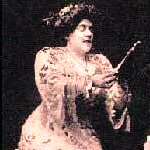
This story is inspired by the true case of Harvey Hawley Crippen. The picture in the left corner of this page is of his wife, Cora Crippen.
If Salem is a perfect gentleman, I'm the Queen of England.


