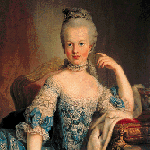
Recalling a Misspent Youth
As the thirty-eighth anniversary of my birth nears—in less than one month's time—I look back upon the past and at the girl I was in my youth. In retrospect, I must admit I led a remarkable life, climbing to the highest peaks to which a woman can go before plummeting to the lowest depths. Prior to my downfall, I led an extravagant life that some people admired, many more envied, most misunderstood and others despised, but it was one few people would ever equal.
It was on a chilly November day that I was born into one of the wealthiest and most politically prominent families in Europe. Being the fifteenth child of my parents' union, my birth had not been accompanied by either breathless anticipation or overwhelming joy. That's not to say anyone was disappointed at my arrival. Far from it. In my parents' world, all children, both male and female, were destined for advantageous marriages that would increase the family's finances and strengthen its political influence.
False modesty aside, I was an extremely attractive little girl, blessed with strawberry blond curls, blue eyes and a flawless complexion. Furthermore, I was possessed of a keen intelligence and a formal education as well as a fun-loving, friendly and generous nature. Given my exceptional beauty and exalted family background, it was little wonder then that I was married at an early age.
While my parents had trained me for such a life, I was but an inexperienced, fifteen-year-old maiden—little more than a child, actually—when I entered into this arranged marriage. The union with my sixteen-year-old husband, whom I had never had the opportunity to meet beforehand, was completed by proxy. A second, more lavish wedding ceremony was later conducted, one which my husband and I both attended.
No doubt most girls of that tender age view matrimony as a grand romantic adventure. I admit that, in that regard, I was no different from the rest. It was not until I realized the sacrifices I was expected to make that my eyes opened to the unpleasant reality of marriage. I was much too young to leave my home and live in an alien world, far away from everything I knew and all those I loved. However, being the female in this venture, I was the one who was required to live apart from my family, say farewell to the country of my birth, give up my prior life and even to change my name.
It is hardly surprising then that those early months of my marriage had been filled with loneliness and despair. How I longed to return to my own country, my childhood home and my parents and siblings, to live the life of a pampered, cosseted child once again. The banishment seemed so unfair to me. I was not yet prepared to take on the awesome responsibilities to which my newfound status as a married woman had sentenced me.
My bleak outlook suddenly changed the day I discovered the many advantages my new role presented. Faced with many fresh opportunities in my adult life, I promptly put aside my foolish adolescent fantasies of grand romance and undying love. If my marriage was not one born of passion, it mattered little to me, for I had, at last, found solace in my adopted country. With great riches at my disposal, I was determined to enjoy the pleasures that accompanied such affluence.
Thus, I unknowingly commenced on my road to ruination at an early age. Dear god, why had no one counseled me to abandon my irresponsible and precarious ways? Why did those closest to me humor my worst inclinations rather than urge me to rein them in? Were those advisors as blameless and undiplomatic as I was, or did they secretly hope to see me fall into disgrace with the public who, at that time, loved me dearly?
Inevitably, along with immense wealth and power came fame, and with fame came the unavoidable curse of celebrity. My private life became a matter of public scrutiny and comment. What I wore, what I ate, how much money I spent, where I went, what I did, who I spent time with and what I said became fodder for the gossipmongers.
Eventually, as my girlhood years became nothing more than vague memories, I fell from favor with the populace. Where I had once been admired and welcomed into my husband's land, I was now criticized for my wanton extravagances. My extensive wardrobe, in which I took great pride and delight, was well known for its splendor as well as its shameful cost. I also spent a considerable fortune on outrageous hairdos, expensive jewelry and lavish entertainment. While many people were starving, I would gamble away vast sums. Ultimately, I came to realize—once it was far too late to rectify my wrongdoings—that such a decadent lifestyle and reckless spending could only lead to trouble. But I was still so young then, and I suffered from the foolhardiness that privileged youth so often brings.
In all honesty, it was not just my lack of financial discretion that made the public turn against me. I was also imprudent enough to bask in the attention of men other than my husband. Innocent though these flirtations were, my behavior did not endear me to those who had already considered me a "selfish, greedy, frivolous and ignorant young woman." Soon I was accused not only of uncontrolled spending but also of adultery, lesbianism and incest. My name was continually reviled by people who knew nothing of my true nature and who cared little for the good that I tried to do.
My detractors were cruel, yet I was too naïve to comprehend how truly dangerous they could be. I had always thought that my husband's money and political power would protect me from my enemies and that they would continue to shield me against the ugliness of life and the forces of hatred. Sadly, I see now that I was wrong.
Happily, intermingled with all these disagreeable recollections of shame and disgrace are the rare and precious memories of the true happiness I have known. Chief among them is the birth of my four children. My two sons and two daughters represent all that was good in my life. Regrettably, these joyous moments were to be short-lived. My infant daughter, whose time on earth was numbered in mere months rather than years, was the first to depart this life. Less than a year later, my eldest son, just seven years of age, joined his little sister in heaven. Before leaving this world, the poor child had suffered from a fatal disease that cruelly struck his spine and left him in agony as his precious life drew to an end.
All the heartache and disappointment I had experienced before paled in comparison to the anguish of a mother's loss of the precious babes she brought into the world. What did reputation and public opinion matter in the face of such a devastating tragedy? I would have gladly suffered a hundred times the pain and heartache I myself had to endure if I could but save my children from their terrible fates.
While I was mourning the loss of my son and daughter, I was so enmeshed in my personal sorrow that I failed to notice the winds of change that were blowing through the land. Extreme poverty and hunger had made the people desperate, and desperate people need someone to blame for their hopeless state. They chose my husband and me as the focal point for their hatred. Who were better suited to the role of scapegoats than the free-spending "whore" and her cuckolded spouse?
Of all the mistakes I have made in my life—and I freely admit there were many—none was greater or would have more disastrous consequences than my stubborn refusal to compromise with those who propagated social reform. In doing so, I created a self-portrait of a callous, profligate ruler who denied her people the common necessities of life. While I feasted at sumptuous banquets, they were starving for want of money to purchase bread.
My folly was compounded by the fact that I had always felt so secure in my position that I underestimated the strength of an angry mob. Throughout human history, the wealthy and powerful minority have almost always suppressed the downtrodden masses. But in France in the year of our Lord 1789, the plebeian population succeeded in overthrowing the affluent upper class.
When we finally saw that the raging tide of revolution was turning against us, my husband and I attempted to flee to safety with our children. However, we were caught and brought back as prisoners. It was not long before cries of liberté, égalité et fraternité rang out as the guillotine removed the heads of the hated aristocrats, including that of King Louis himself.
Alas! Not only did I suffer the loss of my husband, but my heartless jailers also hoped to demoralize me further by separating me from my two remaining children. Hence, it was a disconsolate, pathetic, broken woman who was brought before the revolutionary tribunal and sentenced to death for treason against France.
Now I sit here in my cold, damp cell, pen in hand, writing my memoirs and remembering my early childhood in Austria and then my twenty-three years first as the Dauphine and then as the Queen of France. My elegant gowns, the epitome of French haute couture, are long since gone; I now dress in the tattered rags of a peasant. I no longer wear elaborate powdered wigs, intricately woven with flowers, jewels and lace; instead, my own hair falls about my face, limp, tangled and unwashed.
I am but a pale shadow of that young and pretty Austrian princess who came to the shores of France to marry the Dauphin, the future King Louis XVI. That girl is as dead as her husband and the two innocent children she bore and lost.
The French monarchy has been destroyed, but what of those fervent revolutionists who sought to bring liberty, equality and fraternity to France? They tore down the monarchy, but what will they raise in its place? Will this new France they hope to create be worth all the blood that is being shed on the guillotine? Only time will tell.
As for me, I will not live to see if the meek are destined to inherit the earth or whether a new, more just monarchy will, like the legendary Phoenix, rise from the ashes of the old. For I, the Habsburg princess born Maria Antonia, who was forced to change my name to Marie Antoinette when I came to live in France, will soon pay the ultimate price for my misspent youth.
I, too, will face the blade of the guillotine. Even now, I can hear the tumbrel approach to transport me to the Place de la Révolution near the gate of the Tuileries gardens, the same place where Citizen Louis Capet, former King of France, was beheaded.
As I prepare to leave this world, I pray the riotous mob's thirst for bloodshed will be slaked with the death of the despised "Austrian whore," yet somehow I doubt it.

No, Salem, Marie Antoinette did not really say, "Let them BE cake."


