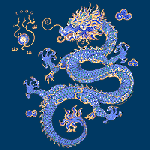
The Dragon Lady
As the bent, gray-haired, haggard-looking elderly woman hobbled along the noisy, crowded, streets of San Francisco's famed Chinatown, no one paid much attention to her. Hers was just one face among many. It was, after all, an unremarkable countenance, one that was easily overlooked by the people who passed by her. To them, one old woman looked much the same as any other.
When she first arrived in this country from her native China many years earlier, the old woman had been in the full bloom of youth. Back then, her slender body had not been bowed by age; it had been capable of standing tall and straight. Her long black hair shimmered like silk whenever she walked, and her flashing eyes held the promise of mysteries soon to be unveiled. The woman's name had originally been Sun Yu Sen, but over the years, like many immigrants to the United States, she had become increasingly more Americanized, and, for a reason she could no longer remember, she eventually came to be known as Anna Lee.
Our story begins on a gray, damp, frigid day in early February. Snow, although a rare occurrence in San Francisco, threatened to fall at any moment; but Anna Lee was not conscious of the menacing weather because her mind was on other, more important matters.
In just a few days' time, on the fifth day of the month, the people of Chinatown would celebrate the Chinese New Year. This particular day would begin the Year of the Dragon, one of the twelve animal signs in the Chinese zodiac. According to an ancient Chinese legend, before the dying Buddha departed from the earth, he summoned all the animals to come and bid him farewell, but only twelve showed up to pay their respects. These included the rat, ox, tiger, rabbit, dragon, snake, horse, goat, monkey, rooster, dog and pig. As a reward for their loyalty, the wise Buddha named the subsequent years after these steadfast animals in the order in which they had arrived.
The upcoming New Year held special meaning for Anna Lee, for she had been born in the year of the dragon. Those born under that sign were said to be powerful, warm-hearted and very lucky. They are thought to be deliverers of good fortune and masters of authority, and, as such, they were to be honored and respected.
In front of a decrepit, nondescript city building that was the old woman's home, Anna Lee stopped, took a key out of her handbag, unlocked the front door and let herself into her small ground-floor apartment. She took off her old, threadbare winter coat, went into her compact, neat kitchen and immediately started preparing lunch.
As Anna Lee chopped bok choy, shitake mushrooms, broccoli and other fresh vegetables, she looked down at her hands. Although still nimble, they had become old and gnarled, and her skin was as dry as leather.
I remember well the time when these hands of mine were young and soft, she thought nostalgically. That was when my hair was not steel gray in color but was a lustrous black. Back when I did not hobble along the streets hunched over like an ogre, but when I had walked proudly with the sleek grace of a jungle cat.
There was no bitterness in the old woman's heart at such thoughts. Aging, she had come to accept, was a part of the life cycle. And, like many of the people from the East, she believed age brought wisdom and experience.
Once Anna Lee finished chopping her vegetables, she cooked them in her bamboo steamer, seasoned them with spices and ate them over fresh-cooked rice. She ended her meal with a cup of traditional Chinese oolong tea.
After her simple midday meal, she began cleaning her apartment—in keeping with an ancient Chinese custom. In China, people thoroughly cleaned their homes at the end of each year, in order to—according to legend—sweep away bad luck and evil spirits. For the Chinese, the New Year was a time of spiritual cleansing and rebirth, a time when people bid farewell to the bad fortunes of the past and looked ahead with hope and anticipation to the future. Thus, for the next several hours, Anna Lee scrubbed, washed, polished, waxed, scoured and swept every inch of the three rooms in her apartment.
Finally, with a great deal of tender, loving care, Anna Lee dusted the many dragon figurines in her treasured collection, some of which she had brought with her from China. She had added to the already impressive collection over the years, and now it appeared to be encroaching upon every nook and corner in her small apartment.
Although the newer pieces would most likely be of little value if she were to sell them, Anna Lee did own a number of figurines that would be considered valuable antiquities, dating as far back as the Ming Dynasty. Yet Anna Lee valued all her dragons equally; they were all priceless as far as she was concerned.
Once a little Chinese-American girl who had learned about Anna Lee's unusual hobby inquired, "Why do you like dragons so much? My mother has read many stories to me about dragons, and they all seem so mean."
Anna Lee laughed and patiently explained to the child, "Those stories are about Western dragons, which are usually portrayed as ferocious beasts that devour fair maidens and terrorize the helpless peasants of medieval villages until they are finally slain by gallant knights. Eastern dragons, on the other hand, are good, kind and intelligent creatures. Although feared in the West, back in China these benevolent dragons are revered, and their history goes back thousands of years. In fact, the five-toed dragons of ancient China were considered imperial dragons and were a symbol of great power."
Most of the inhabitants in Chinatown were familiar with Anna Lee's vast knowledge of dragons and her penchant for collecting them, although few people had actually seen her amazing collection firsthand. It was due to her keen interest in those mythological Chinese creatures that old Anna Lee became known to many of her neighbors as the Dragon Lady.
Once Anna Lee was satisfied that the three rooms of her apartment were sufficiently clean, she began to work on her lantern. The Lantern Festival—one of the old woman's favorite New Year's traditions—signaled the end of the Chinese New Year celebration period. Individuals, couples and sometimes entire families handcrafted elaborate lanterns that would be lit with candles on the night of the festival, symbolically to help the revelers see the gods by torchlight.
From the shelf at the top of her bedroom closet, the old woman took down a large cardboard box that contained a dozen or so sheets of rice paper, several strips of bamboo, a number of bottles of colored inks and a handful of paintbrushes. Even when she was a young child, Anna Lee always had a talent for painting, and her lanterns were usually considered among the most beautifully crafted at the festival. Over the years, she had painted blossoming cherry trees, majestic snow-capped mountains, elaborate pagodas, koi fish, lotus flowers and whimsical panda bears as well as all twelve animals of the Chinese zodiac.
Anna Lee worked well into the early morning hours, laboring by the light of a small lamp until the muscles in her lower back ached from leaning over and her eyes burned from strain and lack of sleep. When she finally completed her task, she was pleased with her creation. False modesty aside, she admitted to herself that the painted lantern was another masterpiece, a true work of art of which she could be proud.
After putting her supplies away, the old woman went to bed, sleeping soundly and peacefully throughout what remained of the night in the knowledge that she was fully prepared for the day to come.
* * *
The morning of February 5 was a cold but clear one. The snow that had threatened the previous day never materialized. All the residents of Chinatown were busy with final preparations for the planned New Year's events. Just as the Western Christian cultures celebrate Christmas, the Chinese on their New Year visit family members and good friends, feast and exchange presents. Most businesses close for the day, for it is a time for celebration, not work. During the festivities, the Chinese-Americans forsake their Western dress in favor of the more traditional costumes of their race, and for the young, ethnic music takes the place of American rock 'n' roll—at least until after the holiday.
Anna Lee had no family in America, and nearly all of her friends had passed away over the years. Thus, she stood alone by the side of the road, enjoying the parade by herself.
As she watched the brightly clad performers, acrobats, elaborate floats and marching bands make their way down Kearny Street, her advanced years began to weigh heavily upon her.
I'm not going to last much longer, she thought. I feel as though if I lie down, I might never wake up again.
After the Golden Dragon, the highlight and finale of the procession, passed by them, the spectators hurried home to enjoy their holiday meals and exchange gifts with their friends and loved ones. The streets of Chinatown would be nearly empty of people until the sun went down and the Lantern Festival and fireworks would begin.
Wearily, Anna Lee made her way through the scurrying crowds, dragging her feet and keenly observing the faces of the people she passed, searching for one in particular.
Eventually, Anna Lee spotted an unaccompanied young woman in the crowd and approached her.
"You are Su Lin, aren't you, my child?" the old woman asked hopefully.
"Yes, and you must be Miss Anna Lee," the attractive young woman answered respectfully.
The old woman nodded her head in affirmation.
Then the young one smiled brightly and said, "I have waited so many years to meet you. You are such a kind, charitable person to have helped support a poor Chinese orphan all these years. And now, you have even made it possible for me to come here to America. How will I ever be able to thank you for all your generosity?"
"You can repay me by coming to my home and visiting with a lonely old woman who, like you, has no family of her own."
"I would be most honored," Su Lin replied, bowing her head to the wise and munificent old woman who stood before her.
Sue Lin, who had been orphaned at seven years of age, wanted to establish a close relationship with the old woman who had sent money to China for many years to help support her. In truth, she already thought of her sponsor as a member of her family.
It was a distance of only two blocks to Anna Lee's apartment building, but even that short of a walk exhausted the old woman. Out of breath, she leaned against the doorframe, trying to regain some small amount of strength.
"Are you all right?" Su Lin asked with tender concern.
"It's nothing for you to worry about. I'm just tired. After I've had a chance to sit down for a few minutes, I'll be fine.
However, Anna Lee's words were lies meant to reassure Su Lin. Instinctively, she knew that her worn-out, old body would not survive the night.
* * *
"Look at all these dragons!" Sue Lin exclaimed when she walked into the apartment.
"They are all part of my cherished collection," Anna Lee proudly announced as she sat down on her reclining easy chair. "I'm sure I told you about them in my letters."
"Yes, you did. But I never realized you had so many! You must have been collecting them for many, many years."
"More than you would believe, my dear," Anna Lee confessed.
Anna Lee put her head back on the cushion and closed her eyes.
"Su Lin, I am still feeling very tired. Would you mind making the tea for us?"
The young girl was delighted to help in any way she could.
The two women sat at Anna Lee's kitchen table, pleasantly sipping cup after cup of tea and talking for the remainder of the afternoon. Sharing the same heritage, they formed an instant rapport and spoke of dragons and of lanterns, of China and of America, of being young and of growing old.
It is almost as though we were mother and daughter, Su Lin thought wistfully. Or, considering the great difference in our ages, more like grandmother and granddaughter.
"It is getting late," Anna Lee declared, putting her teacup down. "We don't want to miss the Lantern Festival."
"Are you sure you're not too tired to attend?" the younger woman asked.
"This may be my last New Year," the old woman replied. "I wouldn't want to miss it. Besides, I spent hours making that lantern. What a pity it would be if no one got to see it. Wait here while I change, and then the two of us will go together."
Su Lin waited patiently in the living room, examining Anna Lee's magnificent handcrafted lantern, while the old woman donned her ancient Chinese robe, one of the few keepsakes she had brought with her from China.
"I'm ready," Anna Lee announced when she stepped out of the bedroom.
Su Lin stared at the majestic robe the old woman wore. Never had she seen a more beautiful, ornate garment. The fine, rich silk fabric was a deep crimson, the color of pomegranate seeds. On the breast of the red robe, embroidered in fine silken threads in shades of gold, white and black, was an elaborate five-toed dragon with two small sapphires meant to represent the creature's eyes.
Appearing almost regal in her beautiful Chinese robe, Anna Lee approached Su Lin.
"Thank you for taking pity on an old woman," she declared as she opened her arms wide to encircle her young visitor.
With sentimental tears in her eyes, young Su Lin beamed with joy and reached out to hug the elderly woman. When their two bodies met, the embrace proved fatal. The Chinese imperial dragon on Anna Lee's robe, which had lain dormant for the past twelve years, awoke from its long slumber, and when it did, it was hungry. With its ancient, powerful and deadly magic, the dragon consumed Su Lin's youth, leaving the poor orphaned immigrant a withered old crone of a woman, gasping out her final breath on the floor of the small San Francisco apartment.
* * *
Anna Lee stood straight, tall and proud in her Chinese imperial robe. Her exquisite long black hair cascading down her back provided a sharp contrast with the scarlet silk of her robe. She watched with neither horror nor compassion as the wasted body of Su Lin completed its tragic, inevitable metamorphosis. Then she bent and picked up the delicate figurine of the dragon—all that was left of the orphan called Su Lin—and placed it on a shelf beside the others.
Young and beautiful once again, Anna Lee grabbed her lantern and set out for the festival. For one year she would retain her youthful beauty and strength. Then she would gradually age until the next Year of the Dragon when she would need to seek out another young woman—at which time the ancient life-and-death cycle would near the end once again.
As the captivating young woman walked through the noisy, crowded streets of Chinatown in her red silk imperial robe, her grace and beauty illuminated by the glow from her masterfully painted lantern, no one suspected that she was actually Anna Lee, the bent, old woman many had called the Dragon Lady.
Anna Lee once tried to steal Salem's nine lives, but I got them back again. I guess we all do things on impulse that we later regret.


