
Contagious
Six-year-old Danica Royce could not wait until Halloween. The previous year, she wore a store-bought Minnie Mouse costume and, due to the heavy rain that fell, she went to only five houses in her neighborhood. Inside her plastic pumpkin bucket were a Reese's Peanut Butter Cup, a snack-size Kit Kat bar, a small bag of Utz potato chips, a mini box of Nerds and a paper trick-or-treat bag containing a roll of Smarties, a Dum-Dums lollipop, two Tootsie Rolls and a piece of Bazooka bubble gum.
"This year, I'm going to get lots of candy!" she vowed.
To make up for her daughter's disappointing experience the previous year, Aida Royce hand-sewed a costume rather than purchased one. The full-length princess dress was made of white taffeta with gold lace trim. Since Octobers in New Jersey were often chilly, she made a crimson velvet, faux fur-lined royal robe to wear over the dress. The final touch was a plastic bejeweled crown she purchased at Party City.
"This is much nicer than Mila's costume," Danica exclaimed when she tried on the gown. "She's going to be Elsa this year."
"I'm sure her outfit will be lovely. Her grandmother bought the dress at the Disney Store near her home in Pennsylvania."
For weeks, the little girl imagined parading down their street, stopping at neighboring houses, ringing doorbells and opening her velveteen bag to receive delectable treats. Unfortunately, on October 29, she was sent home from school with a cough and a fever. The following day, Aida took the child to Dr. Sherwin Hinsdale, the pediatrician, expecting to be told to treat the symptoms with Children's Tylenol and an over-the-counter cough medicine.
"This isn't the common cold," Dr. Hinsdale told her after taking a throat swab. "Your daughter has the measles."
"But she was vaccinated," Aida argued.
"It's rare, but sometimes a vaccinated person can contract the disease."
Danica smiled, glad that he did not prescribe any nasty-tasting medicine, only grape-flavored Children's Tylenol to take down the fever. His next words struck her like a blow, and the smile vanished.
"She'll need to stay in bed and drink plenty of fluids."
Stay in bed! It was as if she had been given a long prison sentence.
"Halloween is the day after tomorrow," she objected. "Can I get out of bed to go trick-or-treating?"
"I'm sorry, but that's impossible. You're contagious," the pediatrician answered.
"What's that?"
"It means you can give the disease to people you come in contact with."
"Good. I don't want it. Let them have it!"
"It doesn't work that way," Dr. Hinsdale laughed. "You'll still have the disease, but you'll spread it to other people."
"But I ...."
"You heard what your doctor said," Aida declared. "You have to stay in bed. You'll just have to miss trick-or-treating this year."
"What about the costume you made for me?"
"I'll make you another one—an even prettier one—next year."
Despite the promise of a new and improved costume, the child was heartbroken. Halloween was another whole year away, and to a six-year-old, those twelve months seemed like an eternity.
* * *
Danica was eight years old when illness deprived her of another long-awaited outing. The third graders in her school were going on a class trip to New York to see the Statue of Liberty. As was the case with trick-or-treating two years earlier, she had counted down the days until the scheduled excursion was to take place. The day before the trip, she woke with a sore throat. She tried to hide the fact from her mother, but Aida noticed the painful grimace when her daughter swallowed a spoonful of cereal.
"Are you feeling all right?"
"Yes. I feel okay."
"You look a little pale," Aida observed, and touched the girl's forehead with the back of her hand. "You feel hot. I'd better take your temperature."
"I'm fine, Mommy."
Ignoring her daughter's protests, Aida got the digital thermometer from the medicine cabinet and inserted it in the child's mouth.
"101.6. I'd better call Dr. Hinsdale."
"No. I can't be sick. I'm going on a trip to New York tomorrow."
"We'll see what the doctor says."
The pediatrician's diagnosis meant the trip to see Lady Liberty was out of the question.
"Those tonsils are infected," he announced.
"Will she have to have surgery?" her mother inquired.
"I prefer not to do a tonsillectomy. Antibiotics ought to clear up the infection."
"Isn't it better to remove the tonsils? I had mine taken out when I was a little girl."
"Science has since discovered that tonsils help fight against inhaled pathogens."
"Since I don't have to go to the hospital, can't I please go to New York with my class?" Danica pleaded.
"No. You don't want your friends to catch the disease, do you?" Dr. Hinsdale asked.
Frankly, that prospect did not upset the child. After all, according to her grandmother, misery loved company. Why should she be the only one to suffer with tonsillitis?
Nevertheless, the decision was not hers to make. Her parents followed the doctor's advice and insisted she stay home from school. Since Dr. Hinsdale's tests confirmed her tonsillitis was viral and not bacterial, there was no need for antibiotics. His prescription, therefore, was simple: stay in bed, drink plenty of fluids and gargle with saltwater.
"It's not fair!" she moaned, scowling at the four pink walls that made up her prison. "Why did I have to get sick? Everybody else gets to take a bus to New York and then a boat ride to see the Statue of Liberty. And I'm stuck here in my bedroom."
If there was one bright side to having gotten sick and missing the class trip, it was this. Before she and her mother had left the pediatrician's office, Dr. Hinsdale had given them some sound medical advice.
"Make sure you take your vitamins," he told his young patient. They're important for supporting your body's immune function and may help reduce the risk of viral infections."
Danica made a promise to herself that day. She would take her Flintstones vitamins religiously in the hope of never getting sick again. Sadly, not even the Hanna-Barbera character-shaped chewables could prevent her from getting the chickenpox when she was ten. As had happened before, the childhood illness could not have come at a worse time. She came down with the highly contagious disease when she was supposed to go to Girl Scout camp.
"But I take my vitamins every day," she swore to the pediatrician. "Why did I still get sick?"
"I'm afraid vitamins alone can't fight off all forms of disease," Dr. Hinsdale replied.
"What can?"
"Nothing, I'm afraid. It's a fact of life: people sometimes get sick. That said, living a healthy life can prevent a good many illnesses."
"What is a healthy life?" the child wanted to know.
"Taking vitamins for one thing."
"Which I do," she reminded him.
"Getting enough sleep. Eating the right foods. Daily exercise."
Danica frowned, perplexed at her doctor's answer.
"How do I know how much sleep is enough?" she wondered. "And what are the right foods to eat?"
Dr. Hinsdale took a pamphlet from his desk drawer.
"Here. This will help."
He handed her a colorful booklet entitled Staying Healthy. Inside were illustrated instructions geared toward children on how to develop healthful habits. This simple aid, given out free of charge by pediatricians across the country, helped set Danica Royce on a course that she would adhere to for many years to come.
* * *
In her freshman year of high school, Danica was still under the care of Sherwin Hinsdale. Although she never missed a regular checkup, she had not needed a doctor since being diagnosed with the chickenpox in the fifth grade. In the intervening years, she followed the advice in Staying Healthy. She got a minimum of nine hours of sleep every night. All the meals she ate were nutritious and in accordance with the food pyramid. And she was an active child, not one to sit in front of a television or video game console for hours on end. She faithfully took her vitamins and had received every vaccination the American Pediatric Society and Centers for Disease Control recommended.
Regardless, as Dr. Hinsdale had told her four years earlier, it was a fact of life that people sometimes get sick. Regrettably, in Danica's case, she always seemed to get sick at the worst possible times. First, it was the measles at Halloween when she was six; next it was tonsillitis before the third-grade class trip to New York; then it was the chickenpox when she was to go to Girl Scout camp. Now, she came down with strep throat when she was to appear in the high school production of Camelot.
Had it not been so painful to talk, she would have screamed her frustration. Of all the freshman girls who had auditioned for the role, she got the coveted part of Guinevere. Even if Dr. Hinsdale, her parents and the school nurse agreed to let her perform, which they most definitely would not, she could barely speak her lines, much less sing the songs in the musical.
"You're not the only member of the cast who had to cancel," her mother informed her the day the play was performed. "The boy who was to play Lancelot is sick as well."
"Donny Wetzel? What's wrong with him?" Danica asked, ignoring the soreness talking caused.
"He's got the same thing as you do. Strep throat."
"How do you know?"
"I saw your music teacher at ShopRite. She told me."
"Did I give it to him?" Danica wondered, feeling guilty.
"No. Mrs. Van Dieman told me he caught it from his brother."
He must have given it to me then, she thought. I suppose it wasn't his fault, any more than it would have been my fault if I had given it to him.
It was another unpleasant fact of life she learned from Dr. Hinsdale. Some diseases spread from person to person, and someone could be in the contagious stage of disease without even being aware of it. Obviously, if she hoped to avoid getting sick in the future, she would have to pay close attention to any possible symptoms. Not a week went by that she did not take her temperature for fear she would develop a fever. A simple sneeze or a tickle in her throat caused her to worry. A headache or cough resulted in a mild panic.
Her doctor had a word for this: hypochondria.
"There's nothing wrong with you," the pediatrician declared when Danica went to his office, complaining of an upset stomach. "The discomfort you felt was most likely the result of eating something that didn't agree with you."
"But all I had to eat was chicken and rice. It never made me throw up before."
"Perhaps the chicken was bad and gave you a mild case of food poisoning. For the next day or so, drink plenty of clear fluids. Avoid caffeine and sugary sodas. Drinks that replenish your electrolytes would be best. If the problem persists, call me, and I'll schedule some tests."
More often than not, Danica's worries were groundless. Thanks to her strict regimen of regular sleep, proper nutrition and plenty of exercise, she managed to make it through her sophomore and junior years without missing a day of school due to illness. Then came her senior year. It was her fourth year playing girls' volleyball, and the varsity team had made it to the playoffs. She had half-expected, given her past disappointments, to wake up the day the tournament started with some rare communicable disease. But she had no fever, no headache and no rash. She didn't sneeze, cough or vomit. She was, in short, a picture of good health.
The same could not be said of Sukey Ammons, a junior on the opposing team. The girl insisted her annoying cough was caused by a seasonal allergy. In a matter of days, though, three members of Sukey's team and two players on Danica's team developed acute bronchitis. One of them was Danica. She managed to play in all the playoff games but had to miss the senior prom.
Tears streamed down her face as she looked at the formal dress she would have worn. Crying seemed to aggravate her cough, but she could not help it. Memories of past disappointments flooded her brain. She recalled the princess dress her mother had made that she never got to wear trick-or-treating. Then there was the class trip to New York. Years later, she still had not visited the Statue of Liberty even though it could be seen from her home state of New Jersey.
"All the cookies I sold to raise money to go to Girl Scout camp," she sobbed. "Manning a booth at the mall on weekends, asking people to buy thin mints and peanut butter patties when other kids were hanging out with their friends. And for what! The other girls in my troop got to ride horses, paddle canoes, cook over campfires and sleep in cabins while I had to stay in my room and suffer through the chickenpox!"
Danica dried her tears and tried not to think about missing her chance to play Guinevere in the freshman year production of Camelot. Oddly enough, Donny Wetzel, the boy who had been too sick to play Lancelot and had most likely given her strep throat, was to have been her prom date. Ironically, she returned the favor by giving him bronchitis when they went out to celebrate her victory at the volleyball tournament.
* * *
"Miracles do exist!" Danica cried as she donned her cap and gown for her graduation ceremony. "This is a milestone in my life, and I'm not sick!"
"Oh, don't exaggerate!" her mother joked. "To hear you talk, someone would think you were sick all the time."
"Not all the time, only when it mattered most for me to be healthy."
"Now stop it!" Aida chastised her daughter. "There are children who have serious, life-threatening diseases. Haven't you ever seen the commercials for St. Jude's and Shriners Children's?"
"You're right, Mom," her daughter apologized. "Missing out on Girl Scout camp or senior prom is nowhere near as bad as having leukemia or cancer."
Danica somehow managed to remain in perfect health for the next five years. Taking many of her college courses online contributed to this feat. She was far less likely to get sick in her own bedroom than in a crowded classroom or lecture hall. Her chosen career, that of a researcher for an educational publisher, also kept her away from the germ-carrying public.
"I don't know how you can stand being cooped up in a library all day!" her mother said. "You never get to meet people. How do you expect to find a husband?"
"I'm not looking for one. Why would I want to get married? I'm perfectly happy living at home with you and Dad."
"Don't get me wrong. We love having you here, but wouldn't you like to have a home of your own someday? Not to mention family."
The thought of having children come home from school with all sorts of diseases made Danica cringe.
"Some women aren't cut out to be wives and mothers."
"Speaking of wives," Aida said. "Your cousin Joni is getting married in October. She's bound to ask you to be one of her bridesmaids."
Danica was torn. On one hand, she loved her cousin and would be happy to be a bridesmaid. On the other, she dreaded being in a crowded wedding venue. Who knew what she could catch in such an environment? Although she eventually agreed to be one of Joni's wedding party, fate stepped in and ruined another day in her life. A week before the wedding, she came down with the flu.
"And you looked so beautiful in the gown!" Aida moaned.
"Oh, well," her daughter sighed. "Such is my lot in life."
On the day of the wedding, despite her high fever and chills, Danica rose from her sickbed and went downstairs to see her parents off.
"You both look so elegant," she observed between fits of coughing.
"I wish you were coming with us," Maxwell Royce, her father, declared.
"I do, too," she said. "I was actually looking forward to it."
The following month, the Danica's family gathered together for Thanksgiving. It was Aida's turn to host the dinner. Newlywed Joni attended with her husband and shared photos and videos of her wedding and honeymoon. Seeing the romantic images of the bride and groom on a beach in Aruba, Danica felt a twinge of envy. Maybe she should get out more and meet new people. After all, her parents would not live forever. Once they were gone, she would be alone.
That's not how I want to spend my final days, she thought, imagining herself a lonesome old woman.
"You're awfully quiet," Aida told her daughter as the two women cleaned the dishes after the company left. "You're not coming down with something, are you?"
"I don't think so, but I'm tired. Must be the tryptophan in the turkey."
"You do realize that that's a myth, don't you? Eating turkey doesn't make you drowsy. No, I think you haven't fully recovered from having the flu."
"Maybe you're right," her daughter agreed, shrugging her shoulders.
"Do you want to make a wish on the wishbone?" Aida asked, having removed all the meat off the carcass.
"Sure. Why not?"
Aida pulled on one side of the bone, and her daughter tugged on the other.
I wish I would never get sick again!
"You got the long end," Aida noted. "That means your wish will come true."
* * *
From the beginning of the new year, Danica made good on her resolution to get out more and meet new people. She joined a book club at the library, connected with former classmates on Facebook and, in hopes of being the next bride in her family, joined an online dating site. She vowed to live life to the fullest and stop being a hypochondriac.
By Valentine's Day, she was in a serious relationship with Russ Berber, a history professor at the state university. Russ had always wanted to visit Egypt and was given the opportunity to book a tour during the month of March which, because it was considered off-season, was offered at a reduced price. Since Danica had never been out of the country, she was eager to join him. For weeks, the couple looked forward to their trip.
"We have a stopover in Dubai," Russ said, looking at the flight information provided by the travel agent. "Then we fly into Cairo. We'll see the sights at Giza and then fly down to Aswan. From there, we take a three-day Nile cruise to Luxor and visit the Valley of Kings before flying back to Cairo."
Danica's head was spinning. She had rarely left the state, and now she planned on flying halfway around the world. She bought a gallabiyah dress for the celebration to be held on the cruise boat. As she looked at her reflection in the mirror, she remembered the princess costume, the prom dress and the bridesmaid's gown she never got to wear. Thankfully, she had not been sick since missing Joni's wedding.
As she and Russ made final preparations for their trip, they paid no attention to the doomsayers on the news who warned about the disease known as COVID-19. Their bags were packed, and they were ready to go, but when Russ went online to check in at the airline's website, there was a problem. The flight had been cancelled. He immediately phoned the travel agent. After being placed on hold for over an hour, he finally got to speak to the agent.
"Well?" his girlfriend asked.
"Not only can't we get a flight, but the entire trip has been cancelled."
Danica laughed at the irony of the situation. Here was another wonderful opportunity she had to miss due to sickness, but this time she was in excellent health.
Although disappointed at having to miss the trip to Egypt, the couple soon moved in together and made plans for the future. Despite living under the government-mandated restrictions, they enjoyed the time they spent together, working from home. When their favorite restaurant was allowed to reopen with reduced seating, Russ took his Danica out to dinner and proposed. Wanting to have a large wedding like her cousin Joni, the bride-to-be wanted to wait until the pandemic was over before getting married. Apparently, so did many other engaged couples. Once the world went back to normal, wedding venues were inundated with reservations.
"There's no reason for us to rush," Russ pointed out. "We can reserve the Meadowview Inn for next year."
"I wanted to get married in June, and next June is already booked," his fiancée whined.
"Then make it for the following June. I don't mind that it's almost three years away. I want you to have the wedding you've always dreamed of."
For the next two years, Danica busied herself with the usual wedding preparations. She purchased a gown. Hired a band. Engaged a photographer and videographer. She also arranged for a limo service, had the invitations and save-the-date cards printed, selected a wedding cake, chose the menu for the reception and found a nondenominational officiant to perform the service.
As for the honeymoon, Russ offered to see to the reservations. Although the cost was much higher than before, he booked the same tour of Egypt.
"I'm not sure how romantic it is to look at mummies of people who died thousands of years ago," he apologized.
"But I'm so looking forward to seeing the pyramids and cruising along the Nile," Danica assured him. "I think it will be a wonderful honeymoon, much better than Joni's trip to Aruba."
Once again, however, disappointment was in the cards.
The world had put COVID-19 behind them. They stopped getting boosters to their initial vaccines and tossed their recommended N95 masks and hand sanitizers in the trash. Social distancing quickly became a thing of the past, and people crowded into bars, movie theaters, concert venues, and theme parks. They went back to school and back to work.
Just when they moved on, the next pandemic moved in. And it was worse than COVID-19.
* * *
When Danica turned on the television and saw the real-time death toll on the screen next to the news anchor who was reporting from his home, she quickly changed the channel. It did little good since the other networks reported the same frightening statistics.
I only want to know what the weather will be tomorrow.
Not that it really mattered. There would be no public funeral. Russ Berber, like her parents and her cousin Joni, was to be cremated. Danica had no choice but to mourn him privately. With more than seventy percent of the world's population lost to the highly contagious disease, bodies were immediately disposed of once death was confirmed.
For the first time in her life, the grieving woman wished she would get sick. Life meant nothing to her without her family. Once her fiancé breathed his last, she stopped taking all precautions to prevent exposure. She refused to get her second vaccination, stopped wearing a mask and even threw out her multiple vitamins.
Meanwhile, health professionals around the globe were busy trying to track the spread of the disease. Dr. Willard Keppel from the CDC paid a visit to Danica six weeks after the love of her life died. Keppel headed a select group of epidemiologists and immunologists who were dedicated to saving the lives of the remaining thirty percent of humanity.
"Miss Royce?" the man in the hazmat suit asked when she opened the door. "I need you to come with me."
She did not argue, nor did she ask what he wanted of her. She simply followed him to his vehicle. When they arrived at the state-of-the-art laboratory, she was told to put on a hospital gown. She was then subjected to a full battery of tests.
"Am I sick?" she asked with no discernible emotion.
"No. On the contrary. You're as healthy as the proverbial ox."
"Lucky me," Danica said, her voice dripping with sarcasm.
"You are lucky. Thousands of people die from this disease every day."
"I'm aware of that. Everyone I know is dead."
"Exactly," Dr. Keppel replied. "That's why you're here. We need to know how you remained in perfect health while everyone around you succumbed to the disease."
After a month of being pricked, prodded and practically drained of blood, the research team made an alarming discovery.
"Have you ever heard of Mary Mallon?" Dr. Keppel asked her.
"No," she answered. "Should I have?"
"She's better known as Typhoid Mary. She was a cook who, in the early 1900s, was believed to have infected as many as fifty people with typhoid fever. It was discovered that she was a carrier of the disease but was immune to it herself."
"Let me guess. You think I'm the Typhoid Mary of this pandemic."
"I don't think it. I know it. The extensive tests we've conducted confirm it."
"Did this Mary Mallon eventually die from the disease?" Danica asked hopefully.
"No. She died of complications from pneumonia thirty years later at Riverside Hospital on North Brother Island."
Dr. Keppel waited for the patient to ask additional questions, but she remained silent.
"She had been quarantined there for the last twenty-three years of her life," he added quietly.
"North Brother Island? Where is that?"
"It's located in New York's East River. The hospital there was designed to isolate patients with contagious diseases such as smallpox, typhus, tuberculosis and scarlet fever."
"I assume you now want to send me there."
"No. Riverside Hospital was closed in 1963."
"Then where am I to go? I don't imagine I'll be allowed to run free and risk killing everyone I come into contact with."
"You're correct. You're to be taken to an isolation ward in the CDC communicable disease research facility in Atlanta. You'll remain there until a cure for this disease has been discovered."
"Given the death rate, isn't it likely that such a cure might never be found or be found too late?"
Dr. Keppel, who was never one to candy-coat a prognosis, preferred not to answer.
Knowing she was basically being sentenced to life imprisonment, she accepted her fate with no objection.
As she was being led out of the lab by two federal agents wearing identical hazmat suits, she turned to Dr. Keppel and said, "A word of advice for you, Willard. Never make a wish on a turkey's wishbone. It might come true."
Failing to understand the patient's cryptic remark, the researcher silently waved his hand in farewell. Within six months, he would be dead, as would the two federal agents and the entire staff at the state-of-the-art laboratory. Meanwhile, Danica Royce remained in perfect health.
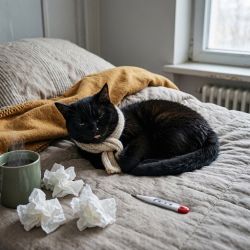
Although Salem doesn't like getting sick, he does enjoy staying in bed.


