Once Lost
"I once was lost, but now I'm found."
—John Newton, "Amazing Grace"
Lori Ann Tenner became fascinated with history at a young age. Throughout her childhood, her father, Robert, a high school history teacher, took his wife and daughter on day trips and summer vacations to historic sites in states along the Eastern Seaboard. Rather than go to Palisades Park, Cape Cod, Coney Island, Atlantic City or Virginia Beach, they visited Gettysburg National Military Park, Independence Hall, Valley Forge, Plimoth Plantation and Fort Ticonderoga. The little girl preferred walking the Freedom Trail in Boston to riding roller coasters at an amusement park. She favored battlefields to zoos and presidents' homes to boardwalk arcades.
In the summer of 1974, before the start of Lori Ann's senior year of high school, the family vacationed in Virginia. After visiting Thomas Jefferson's Monticello, the Lee family's Stratford Hall and George Washington's Mount Vernon, Robert proposed they go to Fredericksburg next and then on to Richmond.
"Can we go to Jamestown and Williamsburg instead?" his daughter asked.
"Fredericksburg is a lot closer. It's less than an hour away if I take I-95."
"But I always wanted to see Williamsburg."
"Maybe next time."
Lori Ann heard that vague promise before. She could not understand her father's reluctance to visit one of the country's most popular historic areas.
"Why is it every time I suggest we go to Williamsburg, you find a reason not to? The place is like a Mecca for American history buffs."
From the back seat, she watched her parents exchange a guarded look. What were they not telling her?
"Please," she urged. "Who knows when we'll come to Virginia again? Didn't Mom say she wanted to go to Massachusetts next summer?"
Siding with her daughter, Doris appealed to her husband, "Maybe we could spend a day or two in Williamsburg."
"Do you think that's wise?" Robert replied in a barely audible voice.
"I don't see what harm it can do."
The father sighed in resignation. Clearly, he did not agree with his wife, nor did he object.
"Fine. I guess I'm outnumbered, but we'll go to Jamestown first," he compromised.
While Lori Ann enjoyed walking through what remains of the first permanent English settlement in America, much of what was there consisted of foundations and archeological sites, and she had to use her imagination to envision what the buildings looked like in the seventeenth century. Happily, the same could not be said of Colonial Williamsburg. Consisting of over five hundred restored or reconstructed buildings, the living-history museum was the size of a small town. The horse-drawn carriages, the fife and drum corps and the tour guides and other employees dressed in eighteenth-century costumes made visitors feel like they had stepped back in time.
"I really like it here, Dad," Lori Ann told her father as the Tenners walked along Duke of Gloucester Street toward the Capitol. "It would be so cool to work here. I wonder how difficult it is to get a job leading a tour of one of the buildings."
"I don't know," Robert responded uneasily, "but you would need to move to Virginia. It's way too far to commute from New Jersey."
Doris, dreading the day her daughter would leave the nest, quickly advised, "It would be best to get an education first. After all, you want to study history like your father did. You should concentrate on getting your degree before you make any decisions about a future career."
"I know, Mom. I have no intention of taking a job right now. I'm talking long-term plans."
Doris was relieved, reassured that Lori Ann would continue to live at home for at least another five years. She was blissfully unaware that her daughter had noticed the College of William and Mary at the other end of Duke of Gloucester Street and had decided then and there to forego attending Rutgers and apply to Thomas Jefferson's alma mater instead.
* * *
At the end of August 1975, the Tenner family returned to Williamsburg. This time, Robert rented a U-Haul to transport Lori Ann's belongings to her dorm room. The parents decided to stay in a nearby motel for several days since they did not plan to see their daughter again until the end of the semester.
"While you're here, why don't we visit one of the plantations along the James River?" Lori Ann suggested.
"Sure. If it's okay with your mother," Robert agreed, turning to his wife.
"If that's what you two want to do, it's fine with me," Doris halfheartedly replied, unable to get enthused about touring historic sites now that her daughter would be living in Virginia.
"I know the perfect one," Lori Ann said. "Carter's Grove. It's been operated by the Colonial Williamsburg Foundation for the past three years, and it's only eleven miles from here."
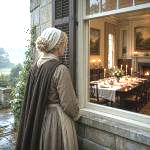
While touring the Georgian-style mansion, the college freshman glanced out of a dining room window and spied a fair-haired woman in costume standing on the lawn, staring at the house.
"Her clothing is all wrong," she muttered.
"What did you say?" Robert asked.
"That woman out there," she answered. "She's wearing the wrong costume. That outfit looks like it dates back at least a hundred years before Carter's Grove was built. She looks more like one of the Pilgrims than a woman from Colonial Williamsburg."
Robert looked at the window and said, "I don't see any woman."
"She's standing right there, Dad."
"I don't see anyone."
"Mom, what about you? Can you see her?"
Doris peered through the window, but, like her husband, saw no one standing on the lawn.
"No. I'm sorry, sweetheart."
Frustrated, Lori Ann again looked out the window. This time, no one was there.
"My eyes must be playing tricks on me. I could have sworn ...."
"It's no wonder you're confused," her mother laughed. "This has been quite a hectic time for you, what with all that packing and the long drive down here, not to mention starting college this week."
But would that cause me to see things that aren't there? the girl wondered.
With her parents' help, Lori Ann was unpacked and moved into her dorm room in under two hours. Once the last of her books were placed on her designated shelf, she suggested the three of them go out to dinner.
"We passed a Chinese buffet about three miles up the road."
"A buffet, huh?" her father chuckled. "Great idea. I'm so hungry I can eat a horse."
"I don't think they have that on the menu," his wife teased. "Chicken and pork, yes, but no sweet and sour horse."
"No horse chow mein?" he countered. "Or horse egg foo young?"
It took four trips to the buffet to fill Robert up. Even after he had already sampled all the main dishes and appetizers, he took a clean plate and went back for dessert. When he finally finished eating, the waitress handed him a small tray that contained the check, surrounded by three fortune cookies.
Lori Ann eagerly cracked one open.
"Answers to the present lie in the past," she read from the small slip of paper inside the cookie. "What does yours say, Mom?"
"A golden opportunity awaits you. What about yours?" Doris asked her husband.
"Perseverance brings good fortune. I guess that means I ought to keep buying lottery tickets."
After leaving the Jade Garden, the parents dropped their daughter off at her dormitory. They said tearful goodbyes before returning to their motel. They were in bed by nine since they planned to leave early the following morning for the return trip to New Jersey.
Meanwhile, Lori Ann was alone in her dorm room. Most students, including her roommate, would not report to school until the next day. She had no television set in her room, so she turned on her transistor radio. As she listened to Paul McCartney sing "The Long and Winding Road," she poured Jean Naté bath bubbles into the bathtub and climbed into the hot, sudsy water. Next, she squeezed a dab of Prell into her palm and worked it through her blond curls. After draining the water from the tub, she stuck her head under the faucet and rinsed the shampoo out of her hair. Wrapping a thick towel around her head, turban style, she stepped out of the tub and into a terrycloth bathrobe. From her dresser, she took out a bottle of Yardley nail polish and painted her toenails and fingernails.
Lastly, she donned a pair of pajamas, turned the radio off, took out the paperback novel she had hidden inside a box of history books and climbed into bed. Thankfully, her parents had not seen the book when they brought her belongings in from the van. She doubted they would approve of her reading Valley of the Dolls. As was the case with Peyton Place, she read it without their knowledge.
* * *
The nightmare began when Lori Ann fell asleep after reading the chapter in which Jennifer North meets Tony Polar. The light beside her bed was still turned on, and the paperback fell from her hands onto the floor. Like most dreams, the nightmare was a surreal mixture of actual memories and impossible fantasies. One moment she was touring Carter's Grove with her mother and father, the next, she was in a field void of all signs of modern life. Telephone poles, houses, automobiles, paved roads and the Georgian mansion itself were gone.
The strange woman she had glimpsed through the dining room window was kneeling on the ground. She suddenly stood up. From the expression on her face, it was clear that she was terrified of something. The reason for her fear became apparent when a Native American war party appeared on the horizon. She tried in vain to run and escape her fate, but she did not get far.
Unable to speak or move, Lori Ann could do nothing but watch as one warrior separated from the group and swooped down upon the ill-fated woman. When the warrior hastened to rejoin his comrades, the college student was left behind with the
woman's mutilated body. She fought the urge to vomit as she stared down at the blood that ran down the woman's face into her flaxen hair.
Mercifully, she soon woke up. It took several moments for her to realize she was safe in bed in her college dorm room.
"It's 1975," she reminded herself. "Relations with the Native American tribes are peaceful today.
Lori Ann could understand dreaming about Carter's Grove since she had visited the plantation earlier that day. Also, the presence of the unknown blond woman made sense for the same reason. But why dream about Native Americans? She could not remember the last time she had encountered one. And why were they on a warpath?
Sigmund Freud would have a field day interpreting this dream, she thought.
Unable to sleep after the disturbing nightmare, she picked up her book from the floor and immersed herself in the problems of Anne Welles, Neely O'Hara and Jennifer North.
* * *
Suzanna Moulton, Lori Ann's roommate, arrived on Sunday afternoon.
"You're a Yankee, huh?" the girl from Charleston joked. "Why did you want to go to college in the South?"
"I fell in love with Williamsburg when I vacationed here with my parents. What about you? Why didn't you choose to go to a university in South Carolina?"
"My father went here, so naturally he wanted me to follow in his footsteps."
During the weeks that followed, the two girls were kept busy getting acquainted with their professors, finding their way around campus, meeting their classmates and getting accustomed to college life in general. That left Lori Ann no time to feel homesick. Eventually, though, she fell into a routine. Despite being from two different regions of the country, the roommates became good friends. They frequently studied together, and occasionally, when time permitted, they drove into town to get pizza or burgers.
It was the last Sunday of September, when Suzanna and Lori Ann were sharing a pie at the local pizzeria that the girl from New Jersey saw the strange fair-haired woman she had glimpsed from the Carter's Grove dining room window. As last time, the woman was dressed in sixteenth-century attire.
"There she is again," she mused aloud. "You know, I bet she works at Jamestown Festival Park. That would explain her outfit."
"Who are you talking about?" Suzanna asked.
"That woman there, standing by the ladies' room door."
"I don't see any woman."
"She's gone. I don't understand. She was there a minute ago," Lori Ann insisted.
"It's no big mystery," her roommate laughed. "She must have ducked into the restroom."
"I'm sure you're right," she said without conviction.
Later that night, a second nightmare plagued her sleep. It began in a similar fashion as the last one. She and her parents were visiting Carter's Grove one minute; the next, she was in a field with the strange woman. As was the case in the previous dream, when she rose from a kneeling position, the war party appeared, and an angry warrior headed toward her."
Lori Ann's screams woke Suzanna.
"What the hell?" her roommate whined.
"I'm sorry," Lori Ann apologized. "I had a nightmare."
"A nightmare, huh? What, were you being chased by Norman Bates?"
"Not exactly," she answered, not wanting to elaborate.
"Well, get back to sleep. We've both got early classes tomorrow."
Suzanna was soon softly snoring, but it would be several hours before her roommate was able to sleep.
The next night, for the second evening in a row, Lori Ann's shrieks of terror woke her roommate.
"Is this going to be an every-night occurrence with you?" Suzanna asked sleepily.
"I hope not."
Regrettably, the nightmares did not stop. Each one began at Carter's Grover plantation and ended in a field with the death of the blond woman. These nocturnal disturbances soon adversely affected both girls. Neither was able to get a decent night's sleep. Although she liked Lori Ann, Suzanna had no choice but to request a different roommate.
"I'm sorry," she apologized, "but I need my sleep. I was so tired that I fell asleep in my psych class yesterday."
"It's okay, really. I understand. I'm exhausted myself."* * *
When Robert and Doris Tenner received the telephone call from the college, they immediately drove to Williamsburg. After meeting with the student advisors, they learned of Lori Ann's nightmares, lack of sleep, increasing nervousness and falling grades and were advised to take her home.
"She can start the year over next semester or the one after that, depending upon how she feels."
"If you think that's best," Doris readily concurred, eager to have her daughter back in New Jersey.
Lori Ann put up no argument. Once she packed her belongings, she obediently accompanied her parents to the same motel they had stayed at in August.
"I was afraid something like this would happen," the worried father told his wife, keeping his voice low so that his daughter, who was in the shower, did not overhear. "That's why I didn't want to visit Williamsburg last year. If we hadn't, Lori Ann might be studying history at Rutgers right now."
"We don't know that," Doris argued. "She might be predisposed to nervousness and depression. After all, we know nothing about her parents."
"My what?" their daughter cried.
"Lori Ann!" Robert and Doris exclaimed in unison.
Neither parent had heard the water in the shower stop or the bathroom door open.
"Aren't you my parents?"
The cat was out of the bag, and there was no putting it back inside. The Tenners had no choice but to confess the truth to their daughter.
"In the 1950s, your mother and I lived in Virginia," Robert began.
"But I thought you were both born and raised in New Jersey," Lori Ann interrupted.
"We were. But I was working in Williamsburg at the time. One of my best friends was a Virginia state trooper." His voice broke, and tears filled his eyes, but he managed to continue his narrative. "One day, he found a baby, an infant. Its parents left it in a field. He knew how we longed for a child."
"The baby was me, wasn't it?"
Robert did not deny Lori Ann's deduction.
"And what? He just handed me over to you? Didn't he attempt to find my real parents?"
"They abandoned you!" Doris sobbed. "And we were desperate to have a family. We tried for years, but I was unable to get pregnant!"
"So, you adopted me?"
"Not exactly," her father admitted. "We were afraid the authorities would find out and take you away from us, so I quit my job, and we returned to New Jersey. We stopped at a hospital in Paterson where I told the doctor that my wife gave birth in the car on the drive north. Lucky for us, the emergency room was extremely busy, so he did not insist on examining your mother. Instead, he filled out the necessary forms that enabled us to get a birth certificate for you."
In 1975, there was no internet, no Ancestry.com, no DNA testing. In short, Lori Ann had no hope of finding her biological parents. It was of no use appealing to the local government agencies since Art Bucknell, the state trooper who found her, had never reported his discovery. Asking her parents was pointless as well, since all the Tenners knew about her birth was that she was found in a field in Virginia, not far from Colonial Williamsburg.
* * *
"We'll have to rent a U-Haul down here to take all this stuff back to Jersey," Robert announced that night at dinner. "You'll have to drive the LTD, and Lori Ann can follow you in her Mustang."
Doris did not like driving her husband's car, especially on a busy highway like I-95, but she had little choice.
"We'll leave first thing in the morning," he continued. "We can stop for breakfast along the way."
"We'd all better get to bed then," Doris advised. "We've got a long drive ahead of us tomorrow."
That night the dream differed from the others, in that before the war party appeared, the kneeling woman placed a small infant with blond curls on the ground and hid it in a patch of high grass. Then she raised her head and spoke to Lori Ann.
"I did not abandon you," she wept. "I tried to save you."
Those were the last words the woman spoke before she was cut down by the angry warrior.
The next morning, Robert's travel alarm clock went off at six. His wife, who slept beside him, stirred.
"Is it time to get up already?" she groaned.
Doris stretched and sat up. Fear gripped her when she noticed the second bed in the room was empty.
"Lori Ann, are you in the bathroom?" she called; there was no answer. "Where can she be, Bob?"
"There are vending machines down the hall. Maybe she went to get something to eat," her husband theorized.
Yet when Doris looked out the window, she noticed that her daughter's Mustang was no longer in the parking lot.
* * *
For three hours, Lori Ann waited in her car for the library to open. When the librarian finally unlocked the door, the girl ran inside and headed for the local history section. After skimming the contents of several books on seventeenth-century settlements, she learned of the Indian Massacre of 1622. Also referred to as the Jamestown Massacre, it consisted of a series of attacks by members of the Powhatan Confederacy on approximately thirty English settlements located along the James River. More than three hundred men, women and children were killed.
Instinctively, Lori Ann knew that she had been a silent witness to what had occurred in the past. Furthermore, she reasoned that the blond woman was her mother and that she had been one of those who were killed in the massacre.
My mother hid me in the tall grass, and I was somehow transported through time to 1957. That's when I was found by the state trooper, who gave me to the Tenners to raise.
The idea sounded preposterous, but Lori Ann believed it to be true.
From 1622 to 1957. That's three hundred and thirty-five years I can't account for. Where could I have been? Was I lost for all that time?
If there was an answer to her question, it would not be found in the pages of the history books. She left the library, got into her Mustang and headed for Carter's Grove plantation.
* * *
Art Bucknell, Robert Tenner's good friend, now retired from the Virginia State Police, came to assist his friends in their search for the missing girl.
"Your daughter's Mustang was found two miles from Carter's Grove plantation," he informed the distraught parents.
"There's something you're not telling us," Doris assumed, noticing that Art did not meet their eyes when he spoke to them. "Were there signs of a struggle? Do you think she's been abducted?"
"No, but ...."
"But what?"
"Her car was located approximately ten feet from where I found her as an infant."
"How did she know where her parents abandoned her?" Robert demanded to know.
"I have no idea," Art replied. "I certainly didn't tell her. I told no one, not even the two of you."
Two days later, Lori Ann had yet to be found. Her parents went to the police and filed a missing persons report. They remained in Williamsburg, handing out flyers, putting up posters, joining search parties and pacing the floor, waiting for the phone to ring. Weeks passed, and there was no sign of the girl. Eventually, they had to return to New Jersey. The police promised that they would immediately notify the Tenners should there be any developments in the case.
* * *
The following year, 1976, America celebrated its bicentennial. The Tenners had no desire to join in the festivities since their daughter was still missing. They were sitting in their living room, watching M*A*S*H, when the doorbell rang.
"I'll get it," Doris volunteered, her voice a dull monotone.
When she saw Art Bucknell on her doorstep, she felt as though her heart sank to the pit of her stomach.
"Is Robert home?" he asked.
She nodded her head and invited him inside.
"Who is it?" her husband called.
"Art is here."
The former state trooper walked into the living room and solemnly announced, "I think your daughter has been found."
"Is she ...?"
The father could not bring herself to say the word.
"I remember exactly what she looked like when I found her back in '57," Art mused once he was seated on the easy chair opposite his old friend. "It's something I've never forgotten. That's how I know it was her."
"What are you talking about?" the mother cried impatiently. "What happened to my daughter?"
The story the retired police officer told was unbelievable. An archaeologist, searching plantation outbuildings on the grounds of Carter's Grove, stumbled upon traces of an unknown English settlement. After extensive research, the identity of the settlement was discovered.
"In 1618, the ship Gift of God left England for the New World," Art explained. "The Society of Martin's Hundred, named after Richard Martin, one of the investors, acquired eighty thousand acres along the James River."
"Martin's Hundred?" Robert echoed. "Does that mean a hundred settlers?"
"No. The British term 'hundred' referred to a tract of land that was capable of supporting one hundred families. With more and more colonists arriving from England, the Powhatan Confederacy feared that the white men would take over their land and force the natives out. In March of 1622, they attacked all the settlements in the Tidewater area. The hardest hit was Martin's Hundred. All but two of its houses were destroyed. Fifty-eight people were killed, and twenty were taken hostage. There were few survivors, and by 1645, the land was uninhabited. When Carter's Grove was built, the site was buried under the plowed fields, and the name was forgotten until now."
"That's all very interesting," Doris declared. "But what has any of this got to do with Lori Ann?"
Art turned his head, not wanting to see the signs of heartbreak etched on the mother's face.
"One of the archaeologists found a body among the ruins."
Doris's hand went to her mouth to stifle a scream.
"It was a body, not a skeleton. The remains were ... fresh. She had only been dead a short time, so there was no decomposition."
Doris could hold back her tears no longer. She fell to her knees and wept.
"Even after eighteen years, I recognized her. The baby was your daughter, Lori Ann."
The grieving parents refused to believe Art's bizarre tale. Also, neither the police nor the archeological team gave it any credence. Who could blame them? How could a seventeenth-century woman send her infant daughter more than three centuries into the future to save her life from the warriors on a warpath? And how could that child, having lived eighteen years in a loving home with the Tenners, find her way back to the past to be reunited with the mother she had never known?
This story was inspired by the actual discovery in 1976 of the ruins of the Martin's Hundred settlement. Note: Carter's Grove was then operated by the Colonial Williamsburg Foundation. It has since been sold and is now a private home.
Salem once visited the dining room at Carter's Grove. He was too busy enjoying the meal to look out the window to see if anyone was outside on the lawn.


