
Unchained
On April 16, 1865, a week after Lee surrendered to Grant at Appomattox Court House, Major General James H. Wilson's Union troops, which had swept through Alabama and seized Selma and Montgomery, raided Columbus, Georgia, the South's last major industrial supply center. One of the final engagements of the Civil War, it ended in a victory for the federal forces. When the guns fell silent, the battle-weary Yankee soldiers headed north, eager to be reunited with their loved ones.
Nolan Wellingsford, son of one of Pittsburgh's wealthiest industrialists, had been drafted into the Army in 1863. Rather than pay the $300 commutation fee or hire a substitute to fight in his stead as so many of his peers did, he patriotically chose to interrupt his studies at the University of Pennsylvania and serve his country. Fortunately, he survived several battles, ending with the one in Columbus. Exhausted, but uninjured, he headed home upon receiving his discharge papers.
Traveling with him was fellow soldier Elroy Hincks, who hailed from Baltimore. The two men crossed Georgia in a northeastern direction, getting rides in farmers' wagons when they could. For the most part, they had to walk since Sherman's March to the Sea had destroyed miles of railroad track, bridges and other infrastructure. When they reached Charlotte, North Carolina, Elroy suggested they travel due east and then north along the coast.
"That's fine for you since Baltimore is a coastal city," Nolan pointed out. "But Pittsburgh is on the western side of Pennsylvania, nowhere near the Atlantic."
"You're talking about going through the Blue Ridge Mountains," his companion argued. "My way will be a lot easier to traverse and quicker in the long run."
Regardless of the steep terrain of the northern route, Nolan thought it was ridiculous for him to travel east when his home was due north. Since he could not convince his friend to change his mind, Elroy reluctantly bid him goodbye and began walking east.
As Private Hincks had predicted, Wellingsford's was a difficult and time-consuming journey.
"At least it's not winter," Nolan said, looking on the bright side. "And it's always cooler in the mountains during the summer. With any luck, I'll be back in Pennsylvania before the snow falls in November or December."
By October, he made it halfway through West Virginia. He envisioned the moment, perhaps in the next few days, when he could cross the border into Pennsylvania. By that time, with any luck, he might come across a telegraph office. If so, he could send a message to his father and ask him to send a carriage to collect him.
The returning soldier was thus weary but optimistic when he came upon the Cumberland Inn. It was the first public house he had encountered in over a week. He was pleased at the prospect of having a hot meal and a warm bed for the night. Orville Mull, the proprietor, a Union sympathizer, welcomed Nolan to the tavern.
"Heading home?" he inquired.
"Yup."
"And where would that be?"
"Pittsburgh."
"You still have a ways to go, then. Which route are you planning on taking?"
"Straight up north."
The innkeeper frowned.
"You might want to avoid the woods. If I were you, I'd circle around them by going either east or west."
"And why would I want to add more miles to my journey?" Nolan asked.
"Because that way you'll avoid encountering Dulcie Kates. She lives in those woods."
"Oh? Is she going to come after me with a shotgun for trespassing on her property?" the soldier chuckled.
"Folks 'round here claim she's a witch."
Nolan broke out into peals of laughter.
"A witch? What is this, the seventeenth century? No one believes in witches anymore."
"Maybe not in Pittsburgh," Orville contended, "but here in the mountains of West Virginia, we do."
"Okay. Well, can you tell me where the nearest telegraph office is located?"
"Most likely in Morganville, which is just this side of the Pennsylvania border."
"There are none any closer?"
"Like I said, this is the Appalachian Mountains. It isn't Philadelphia or Pittsburgh."
"Damn! I want to contact my father."
"You can always send him a letter. We do have a post office," the innkeeper quipped.
"I want to ask him to send someone to come get me. By the time he receives a letter and arranges for a carriage and a driver, I might as well keep walking."
Having finished his meal, Nolan paid for both his food and a bed for the night.
As the young man headed up the stairs to his lodgings, Orville Mull called to him, "Remember what I told you about Dulcie Kates. You best heed my warning and go around the woods."
* * *
Disregarding the publican's advice, Nolan Wellingsford set out at dawn, heading for the woods. He had been taught that the shortest distance between two points was a straight line, and he fully intended to travel straight toward Pittsburgh.
What have I got to fear from a so-called witch? he thought arrogantly. I've slain my share of Johnny Rebs. Surely, I can defend myself from an old crone.
For several hours, he followed the mountain trail, but by midmorning, the dirt footpath dwindled, and he had to force his way through dense trees and thick undergrowth. Briefly, he regretted his decision to bypass the woods but quickly quashed this notion and trudged on. Soon, the forest canopy grew so heavy that sunlight barely penetrated it.
"It's as dark as night, yet it can't be later than three o'clock, he reasoned.
The rumble of distant thunder presaged an imminent storm. Hopefully, the leaves on the trees would protect him from the worst of the rain. Unfortunately, the strong winds parted the branches, allowing the raindrops to mercilessly pelt down on him. With nowhere to take shelter, he kept on walking. His uniform was saturated, and his skin was soaked. Soon, he began to shiver.
Before the sun set, he spied a small cottage up ahead. Smoke poured out of the chimney, attesting to the fire that burned within. As Nolan got closer, the aroma of roasting meat made his mouth water and his stomach growl with hunger. He boldly marched up to the house and knocked on the door.
"Yes?" asked the young woman who answered.
The soldier stared, speechless, at what he considered was the most beautiful woman he had ever seen. Her hair was a fiery shade of red, and her eyes were the color of a clear blue sky.
"You are drenched," she observed. "Won't you come in and dry off in front of the fire?"
He quickly crossed the threshold before she changed her mind. "What are you doing in these woods? You are a long way from any town. Are you lost?"
"I've been traveling since April, heading home from Georgia to Pennsylvania."
"You must be tired and, I assume, hungry."
"Yes, ma'am."
"What is your name?" she inquired.
"Nolan Wellingsford."
"Tell me, Nolan, would you like to share my supper with me? I've made a stew with beef and potatoes."
"I would, ma'am. Thank you. And what is your name?"
"Dulcie Kates," the beauty replied.
"The witch?"
Her laughter made her blue eyes sparkle like sapphires.
"You've been talking to the ignorant peasants in the village, I see."
"The man at the Cumberland Inn warned me about coming through these woods."
"What do you expect?" she scoffed. "All the people around here are superstitious, ignorant fools."
Dulcie removed a worn uniform from a chest in the corner of the room and tossed it to her guest. The insignia indicated that it had once belonged to a Union sergeant.
"Take off your wet clothes and put that on," she instructed.
"Did this belong to your husband?" Nolan asked, getting undressed.
"I'm not married. Never have been."
"Then how did you come by this uniform?"
"Do you think you're the only Yankee to come into these woods?"
"Where did he ...?"
"Enough questions," she said, putting a steaming bowl of stew in front of him. "Eat."
The hungry soldier quickly devoured his meal and was given a second helping. When he had finished that, Dulcie poured him a glass of what he assumed was moonshine.
"I'm not one for strong spirits," he protested.
"Drink up. After being out in that downpour, you're likely to get sick. A few good swigs of that will help fight it off."
Nolan took a sip and grimaced at the awful taste. He tried to hand the glass back to her.
"Drink it all up. If you don't like the taste, then guzzle it all down at once."
Not long after the glass was empty, the soldier began to feel lightheaded. He attributed the cause of his condition to his unfamiliarity with hard liquor. He was about to apologize for the disgraceful state he found himself in, but when he looked toward the kitchen area, he became speechless.
"Who are you?" he demanded to know. "What happened to Dulcie?"
The redheaded, blue-eyed beauty was gone. In her place was a hunchbacked, gray-haired crone with menacing black eyes.
"I'm right here," the witch cackled.
* * *
Thaddeus Wellingsford sat in his private office, nervously drumming his fingers on the massive oak desk when his secretary opened the door and let the Pinkerton detective into the room.
"Mr. Wellingsford, my name is Everett Lemp," the private investigator introduced himself.
"Have a seat, Mr. Lemp."
"I understand you're in need of my services. What can I do for you?"
"I want you to find my son. He was discharged from the Army back in April of 1865. My wife and I expected him to come home once the war ended, but we haven't heard a word from him."
Everett removed a notepad and pencil from his jacket pocket to take notes.
"Can you tell me about your son's Army experience, sir? Under whom did he serve?"
"James H. Wilson. I have a friend in Washington who confirms Nolan fought at the Battle of Columbus."
"That's in Georgia, isn't it?"
"Yes," the worried father confirmed. "It was where he was discharged."
"And that was the last time you heard from him, correct?"
Thaddeus nodded solemnly.
"Then that shall be my starting point," the Pinkerton man declared, pocketing his pencil and notepad. He rose from his seat and added, "I shall set off for Georgia first thing in the morning."
"Good. And you'll keep me posted?"
"Yes, sir. I'll report to you every week, and needless to say, I will contact you immediately if I learn something important."
Everett began his search by interviewing the Union soldiers who had remained in Columbus, Georgia. Even those who knew Wellingsford, however, had no idea what had become of him after peace was restored. Everett reached out to his contacts in the War Department to find a list of the survivors of the Battle of Columbus. Most of them had returned to their homes in the north, so his investigation next took him to New England and mid-Atlantic states. He spoke to over fifty men before he found one who knew where Nolan went after being discharged.
"He and Elroy Hincks left together," the missing man's former comrade-in-arms informed the detective.
"Do you know where they were going?"
"Home. For Nolan, that was Pennsylvania, and for Elroy, it was Maryland."
Following up on that interview, Detective Lemp made the relatively short trip from Washington, D.C., to Baltimore. He found Private Hincks working in his father's dry goods store.
"Nolan and I left George together," Elroy confirmed. "We got as far as Charlotte."
"North Carolina?"
"Yes, sir. I told him we would make better time if we travelled east, but he was stubborn. He insisted on going north."
"He planned to travel through the mountains on foot?" Everett asked.
"Yup. Damned foolish, huh?"
"It certainly was. Not only because of the high elevations of the Blue Ridge Mountains but also because of the remoteness of the area. Pockets of civilization are few and far between. Finding food and lodgings would be difficult."
"Not to mention the black bears and poisonous snakes he might encounter."
When Everett wired his weekly report to Thaddeus Wellingsford, he did not convey his concern for his son's safety. He told his client simply that Nolan was last seen in Charlotte. Thus, he would travel to North Carolina and try to pick up the missing soldier's trail.
Traveling on horseback, the Pinkerton detective hoped to gain ground on his target, who was on foot. He made a systematic canvass of lodgings and public houses from Charlotte, through the western part of Virginia and into West Virginia. Thaddeus had given him a photograph of his son that he showed to bartenders, innkeepers, waiters and hotel staff. Despite many dead ends, Lemp persisted and was somehow able to track Nolan to the Cumberland Inn.
"What can I get for you?" Orville Mull asked when Everett entered the tavern.
"Whiskey."
When the proprietor placed a glass in front of him, the detective removed the photo from his pocket.
"Have you seen this man?" he inquired mechanically.
"Him? Sure did."
The Pinkerton man's mood brightened.
"When?"
"Let me think. It wasn't long after the war ended. September? No. October. He came in one day, ordered a meal, spent the night in one of the rooms and left the next morning."
"And did he say where he was going from here?"
"Home to Pennsylvania. Why are you asking about him?"
"Because he never made it back home. His father hired me to find him."
Orville laughed, but there was no humor in it.
"Frankly, I'm not surprised."
"You're not? Why is that?"
"I told him to avoid those woods, but he wouldn't listen."
The man's words piqued the Pinkerton man's curiosity.
"Woods? What woods?"
"The woods to the north. I told that young man to go around them."
"Why?"
"Because of the witch."
Whereas Nolan refused to listen to the innkeeper's superstitious warnings, Everett paid close attention.
"A witch, you say?"
"Dulcie Kates. She has a cabin in those woods," Orville clarified. "Many a man entered those woods but never came out. All of them Yankees like your missing young man."
"She has something against the North?"
"This land here was once part of the Commonwealth of Virginia. It wasn't until June of 1863 that the state of West Virginia was created. And where most of us folks support the Union, Dulcie Kates, witch or not, is a Confederate."
"And you think Nolan Wellingsford went into those woods, came upon the witch and she killed him?" the detective asked.
"I don't know for certain, but I had a hunch she did. And since he never made it back to Pennsylvania, I guess I'm not wrong."
* * *
While Everett Lemp did not believe in witches, he was no stranger to angry, vindictive Confederates. Rather than enter the woods alone and confront Dulcie Kates himself, he telegraphed Allan Pinkerton, informing him of the situation. He was told that a platoon of soldiers would be sent to assist him and was instructed to wait at the Cumberland Inn for their arrival. Since many Union soldiers were still stationed in the war-torn South to help keep the peace during Reconstruction, he did not have long to wait.
Twenty cavalrymen in blue rode up to the Cumberland Inn late one morning and asked to speak to Allan Pinkerton's man. Lemp briefed them on Nolan Wellingsford's disappearance and the rumors surrounding Dulcie Kates's Confederate sympathies.
"So, you think this secesh lured him into the woods and killed him?" Lieutenant Wesley Tabron asked.
"According to the innkeeper here, a number of Union men have gone missing in these woods."
As he spoke, Everett saddled his horse, preparing to join the soldiers.
"I'd just as soon not take a civilian into what might be a dangerous situation," Wesley declared.
"I may be a civilian now," the detective objected, "but I fought under Hancock at Gettysburg."
"Then, by all means, come along. Afterward, perhaps you'd be so kind as to join me for a drink at the inn and tell me what Pickett's Charge was like."
"Certainly."
It was not long before the men entered the dense woods. As they neared the cabin, Tabron ordered his men to dismount and conduct a thorough search of the woods.
"Lieutenant!" one of the young privates called out. "We've found something."
When Everett saw skeletal remains wearing a tattered blue uniform, he assumed the body was that of Nolan Wellingsford. He would, of course, have to tell Thaddeus about his son's fate, but he hated having to do so by telegram.
"Over here, sir," another voice rang out from fifty yards away.
A second body was discovered. Shortly afterward, a third and fourth were found, all of whom were murdered Union soldiers.
"The rumors are true," Detective Lemp muttered.
"It appears so," Lieutenant Tabron agreed. "I'm afraid it does not bode well for your client's son."
After a cursory examination of the bodies, the detective concluded that the men had been bludgeoned. All their skulls had been crushed.
"We'd best go find this woman and take her in," the lieutenant advised. "Woman or not, she'll hang for this."
"Just like they did in Salem," Everett mused.
"Is that Salem, North Carolina, or Salem, West Virginia?"
"Neither. Salem, Massachusetts. They hanged witches there, too."
The lieutenant was confused by what he assumed was a non sequitur.
"Oh, I forgot to mention it before," the detective clarified, "Dulcie Kates has a reputation of being a witch."
"A witch, huh?" Wesley jeered. "These men weren't killed with a curse or a magic spell. They were hit over the head with something heavy. Still, witch or mortal woman, she'll stand trial and be executed if she's found guilty."
When they came upon the cottage, the lieutenant ordered his men to surround it. Dulcie looked out her window, saw the blue uniforms and shrieked with rage. She did not bother transforming into the beautiful redhead Nolan had first seen. Instead, she appeared to them as the gray-haired, wrinkled hag she actually was.
"Damn Yankees!" she bellowed. "Get off my property!"
"What have you done with Nolan Wellingsford?" Everett demanded to know, hoping to mitigate Thaddeus's grief by bringing back his son's remains for a proper burial.
"He's dead," the witch bragged. "I killed him. One less bluebelly in the world."
Having served in the Army himself, the detective knew that many men kept some form of identification on them when they went into battle in hopes that if they were killed, their families might be notified of their fate.
"I'll need to check the bodies we found; one of them might be Nolan Wellingsford."
"And my men will continue to scour these woods," Wesley stated. "We might not have found all the victims."
* * *
Eventually, thirty-three corpses in varying states of decay, all former Union soldiers, were found. Dulcie Kates did not deny that she had killed them. On the contrary, she was proud of what she had done, seeing it as striking a blow for the South. Dulcie was then arrested and taken to Morganville to stand trial. Thaddeus Wellingsford made the journey from Pennsylvania to attend the proceedings and to accompany his son's casket back to Pittsburgh.
Spectators arrived in droves, and the trial took on a carnival-like atmosphere. Vendors hawked food, and people brought picnic lunches. One enterprising man sold tiny wooden gallows as souvenirs. Not to be outdone, a woman had sewn witches from black fabric, which were popular with the women and children.
Given Dulcie Kates's boastful claims during her testimony, the verdict was a foregone conclusion. The sentence was a speedy one. She was to be taken outside the courthouse the following day and hanged. The next morning, as she climbed the steps to the gallows, the condemned prisoner held her head high and arrogantly spoke to the assembled onlookers.
"I was born a Virginian and was proud to be one. Then, in June of 1863, a bunch of no-good traitors seceded from our Confederate state and rejoined the Union as West Virginia. Lee may have surrendered to Grant at Appomattox, but I chose to continue the fight. While I succeeded in killing only thirty-three Yankees, I'm not done yet. You may hang me today, but I will return. I'll come back and finish what I started. I'll kill Yankees until the so-called State of West Virginia is once again part of the Commonwealth of Virginia."
Having issued her threat, Dulcie Kates fell silent. The hangman put a black hood over her head and slipped the noose around her neck. A court officer read the death warrant aloud. Moments later, the hangman tugged on the lever, and the witch fell to her death as the crowd cheered.
"All right, folks, show's over," Sheriff Algernon Sidwell called, dispersing the crowd.
Once the road was cleared, Silas Pimm, the undertaker, arrived, carrying a pine box on his buckboard. As Silas held on to the witch's body, Sheriff Sidwell took out his knife and cut the rope that was still attached to the gallows. When the corpse was released, the hood and noose were removed.
"Good God!" Pimm exclaimed, letting go of the body as if it carried a deadly disease.
"What the ...?" the sheriff cried, seeing not a corpse of a wrinkled old hag, but the body of a redheaded young beauty.
"Did they hang the wrong woman?" the undertaker wondered.
"That's no woman," Algernon answered. "It's a witch."
In light of what he considered proof that Dulcie Kates was a supernatural being and her threat to return and commit more violence, the sheriff ordered heavy chains to be wrapped around her coffin before it was placed in the ground.
"That'll keep her in place," he asserted, fastening the last of several padlocks to secure the chains.
"Just in case," Silas Pimm sheepishly said, placing a pewter cross on the coffin lid. "The Almighty will see that this devil's spawn stays put."
* * *
Although West Virginia Day would not become an official holiday until 1927, many residents celebrated the founding of their state long before then. On June 20, 1873, the people of Morganville gathered together to commemorate the tenth anniversary of statehood. The planned festivities included speeches by local politicians, a band concert, a parade and a fireworks display.
It was a warm, sunny day, and the streets were crowded with many of the same people who had attended Dulcie Kates's hanging, but no one gave a thought to the accused witch whose body was buried in the town cemetery. The musicians were on the bandstand, tuning their instruments. Former sheriff Algernon Sidwell, now the mayor, was in his office in the town hall, practicing his speech. Rufus Allerman, the man who replaced him as Morganville's chief law enforcement officer, abruptly burst through the door.
"What do you want?" the mayor shouted, angry at the interruption. "Can't you see I'm busy?"
"This can't wait," Sheriff Allerman claimed. "Hunters found three dead bodies in the woods."
"So? What am I supposed to do about it? I'm no longer sheriff. You are."
"All of them were former Yankee soldiers. And ...." Rufus briefly hesitated before delivering the final bit of news, "they all had their heads bashed in."
The mayor's eyes widened.
"Could someone be replicating Dulcie Kates's killings?" Sidwell asked, his face pale with fear.
"No. I'm afraid it's worse than that," the sheriff answered. "I went to her grave. Not only has the ground been dug up, but the chains have been broken. And ... the coffin is empty."
Algernon ran to the window and gazed out at the throng of people gathered in the town square below, many of whom were veterans in badly fitting blue uniforms, members of the Grand Army of the Republic, singing "Battle Cry of Freedom" as the band accompanied them.
"Those men have no idea what danger they're in," he said forlornly. "And there's not a damned thing we can do to help them. The state legislature is never going to believe that a witch will keep killing former Union soldiers until such time as we are reunited with Virginia."
As the mayor stood at the window, helpless, he watched a redheaded young woman approach a man who had been in Lieutenant Wesley Tabron's platoon on the day Dulcie Kates was arrested. She smiled at the former private, and he was clearly enamored of her beguiling beauty. Sidwell desperately wanted to open the window and warn the unsuspecting man of his peril, but he took no action.
What good will it do? he thought pessimistically. Somehow, she will kill him. If not today, then tomorrow, the next day or the day after that. What a fool I was to think chains would hold her when not even death itself could deter her from her warped sense of vengeance.
This story is inspired by the legend of the Witch of Yazoo, who, before she died, swore to return in twenty years and burn Yazoo City to the ground. To prevent her from carrying out her curse, officials had her coffin bound in chains. Twenty years later, a fire swept through Yazoo City, destroying over 200 homes. After the fire was extinguished, residents found the chains around her grave broken.
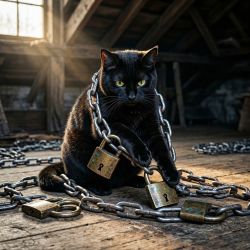
No need to worry. Salem is trying to perfect his Harry Houdini spell.


