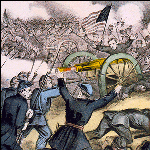
Someday
"Someday," Kira Watson said with a sigh as she turned away from the jewelry store window.
Her fiancé, Xander Lipton, took one glance at the price tag beneath the diamond engagement ring, frowned and turned away, too. He had hoped he could purchase a ring on credit, but the cost of even the least expensive one would put him over the limit of his Visa card.
"I don't know how the average person can afford to get married these days, much less buy a house and start a family," he complained.
"Don't worry," Kira said encouragingly, taking hold of his arm. "Someday your student loans will be paid."
The cost of his education, although by far the most significant amount he owed, was not the only debt hanging over Xander's head. There were also car payments, rent, insurance, credit card bills and utilities. Kira contributed what she could to their joint checking account, but college secretaries did not make much money. Unfortunately, neither did high school history teachers.
Xander was so disheartened by his financial inability to buy his fiancée an engagement ring that he nearly forgot to tell her his good news.
"Guess what. I've been offered a part-time job," he announced excitedly.
Kira was less than overjoyed by this sudden announcement since it meant she would be seeing less of him, but she knew that sacrifices had to be made so that someday they would be able to have the home and family they both wanted.
"What will you be doing?" she asked, forcing a smile of support. "Coaching basketball?"
"No, I won't be working at the school. I'm going to be a guide for Haunted History Tours."
Haunted History was a name well-known in Gettysburg. Several years earlier local historian Creighton Barnett had written a book about reported paranormal experiences on and around the famous battlefield. His stories of phantom Civil War soldiers were so popular that his work soon spawned an entire series of books, as more townspeople and tourists wrote to him and reported their own encounters with the world beyond. Eventually, a local inn began offering ghost tours of Gettysburg and paid Creighton Barnett for the use of his name.
"What do you know about ghosts?" Kira asked.
"Not much really," Xander admitted, "but as a history teacher and battle reenactor, I know a lot about the events that took place here in 1863. All the spooky stuff the tourists eat up I'll learn from the woman who is going to train me."
"It might be fun," Kira said with encouragement. "Sort of like having Halloween all year round."
"The money isn't bad either. I get a decent hourly rate plus tips. That could mean quite a bit of extra cash during the height of the tourist season."
Kira's mood suddenly improved. Perhaps she could type and edit term papers on the evenings that Xander was leading curious tourists through the battlefield and along the streets of Gettysburg. With both of them bringing in extra money, their someday might come a little sooner.
* * *
Throughout the spring Xander taught his high school students U.S. history during the day; and on Friday, Saturday and Sunday nights he entertained groups of tourists who were eager to witness a vaporous orb near Little Round Top, to have their camera malfunction at Devil's Den or to hear a ghostly tale about the tragic death of young Jennie Wade.
In his free time, Xander read his way through Creighton Barnett's Haunted History series. One day, he came home after work, eager to tell Kira what he had read that day during his lunch hour.
"Did you know the building you work in is supposedly haunted?' he asked.
"Really? By whom? The ghost of a former student?"
Kira had already learned from Xander that not all the ghosts in Barnett's books originated during the famous battle. Like other cities and towns across the country, Gettysburg had its share of murders, suicides and unexplained and violent deaths, most of which had a ghost story attached to them.
"It has nothing to do with the building's use as an educational institution but rather with the brief period of time it was used as a field hospital during and shortly after the battle."
"No kidding? Is that where that poor wounded soldier who was presumed dead was buried under a pile of corpses?"
"No, that took place in a barn. The story I read about the college is even more bizarre. Several people who have taken the elevator in your building claim to have heard calls for help and cries of pain that they believe were coming from the ghosts of wounded and dying Civil War soldiers."
"Why in the elevator?" Kira asked. "That didn't even exist back in 1863. It was added many years later when the building was renovated."
"Don't ask me to explain. I'm just telling you what I read."
Since Kira worked on the second floor of the administration building she had little reason to take the elevator. It was usually much quicker to walk up or down a flight of stairs than it was to wait for an elevator car. In the years she worked at the college, though, she had on a few occasions taken the elevator from the fourth-floor library down to the lobby and had never seen or heard anything out of the ordinary.
* * *
When school ended the first week of June, Xander Lipton got a summer job working for a construction crew. It was hard work, but the pay was good—much better, in fact, than his salary as a teacher.
"Perhaps I should reconsider my choice of career," he told Kira after receiving his first paycheck. "Construction pays much better than teaching."
"But the work isn't steady. My uncle was a construction worker. He cleared $3,000 a week when his company was working under contract, but then he would be out of work for six or seven weeks at a time. Teaching may not pay that well, but the work is steady and you have decent benefits. Besides, I thought your ultimate goal was to write a book on the Civil War. I would think a history teacher would have a better chance of being published than a construction worker would."
"Sure, I'd love to be a writer. I've dreamt of it for years, but it's time to be practical. We scrimp and save, and still, we just manage to make ends meet."
"Someday ...," Kira began.
"The hell with someday! I'm tired of waiting for some elusive time in the future. Life is too short, and we have no guarantees that we'll live to a ripe old age. I want to be able to see my children grow up, to hold my grandchildren in my arms."
Kira hugged him, and whispered in his ear, "Someday."
* * *
June ended, and July barged in with temperatures topping ninety degrees. On the evening of July 2, there was a brief respite from the sweltering heat. When the sun went down, the temperature fell to a comfortable seventy-eight degrees, the humidity dropped and a cool breeze blew through the streets of Gettysburg.
Kira worked late that night, helping the librarian prepare a budget for the upcoming semester. Her eyes were tired, and she needed a break, so she walked to the fourth-floor window, opened it and breathed in the fresh night air. She looked below her and saw in the distance, heading up Washington Street, a group of tourists led by a guide carrying a lantern. That would be one of the ghost tours, she realized. It might even be one of Xander's.
Kira turned toward the clock; it was almost ten. Suddenly, the long hours got the best of her. She was tired and decided the work could wait until Monday. She shut down the computer, grabbed her purse and headed for the elevator. When the doors closed, Kira pressed the button for the first floor. A few moments later the elevator bypassed the ground floor and went down to the basement. Again, she pressed the first-floor button, but the elevator did not ascend. Instead, its doors slowly opened. Kira stared in horror not at the college's storage area but at a window to the past.
Candles and lanterns dimly illuminated the horrific scene in front of her. One lone doctor, covered in blood, was operating on a seriously wounded soldier. Around him, overworked orderlies were changing bandages, carrying in new patients and removing those poor souls who were beyond the doctor's help.
As Kira repeatedly pushed the button to close the elevator doors, the doctor removed a gangrenous leg and threw it onto a pile of amputated limbs. The young secretary felt her stomach turn and tried to look away, but the doctor's eyes met and held hers.
"Help me, please," he begged her. "There are so many wounded men and so few doctors and nurses to care for them."
Kira was stunned. Could the man see her? If so, why didn't he seem in the least bit surprised at her twenty-first-century appearance?
"Please, miss," he pleaded. "These wounded men desperately need your help."
Kira took a hesitant step forward, and the stench of death and disease suddenly overwhelmed her. She covered her mouth and shook her head. What good would she be as a nurse? She was far too squeamish to withstand her surroundings.
"I'm sorry, but I just can't," she said weakly.
The doctor looked defeated. The man whose leg he had just amputated unexpectedly convulsed and died. The doctor signaled to an orderly to remove the body, and then he turned to another patient.
Kira's tears misted her eyes. She had lived in Gettysburg all her life and was well aware of the carnage that had occurred there during those three fateful days in July 1863, but nothing had made it so painfully clear to her as the tragedy that was unfolding before her eyes.
Panic set in. Kira took a step backward into the elevator and frantically pressed the CLOSE DOOR button. Then she looked at the doctor's new patient, and fear left her heart at the sight of his young face—a face that could not yet have seen its sixteenth year. Compassion welled in her breast when the wounded young soldier turned toward her. Without any thought as to whether or not she could ever return to her own time, Kira Watson bravely stepped into the past.
"Thank God, you've decided to help," the doctor said, paying no attention to the strange clothing she wore or the mysterious "box" from which she emerged.
The doctor gave her quick instructions that she carried out without protest. Though normally upset by the sight of blood, Kira performed as capably as an experienced emergency room nurse.
Hours passed, and the college secretary and the army physician slowly worked their way through the patients in the room. Finally, as dawn broke in the east, there was a brief lull in activity. The doctor sat on a cot and immediately fell asleep, seeking what rest he could before more casualties were brought in.
While the doctor napped, Kira went to check on the young boy whose compelling green eyes had brought her back more than one hundred and fifty years in time. She took a wet rag and washed the blood, perspiration, gunpowder and dirt from his handsome face.
"That feels good," he said gratefully.
"Are you in much pain?" she asked, looking at his bandaged chest.
"It's not too bad," he replied. "The ache in my head feels worse than anything else."
Kira found her pocketbook, reached inside and took out a bottle of Advil.
"Here. Swallow these," she said, fetching him a dipper of water to wash the tablets down.
Then, as she leaned forward to put the bottle back, she dropped her purse, and the contents spilled out onto the floor. She got down on her hands and knees, scrambling in the dimly lit room after her wallet, keys, lipstick and other personal items. Once her belongings were safely back in her pocketbook, Kira resumed her conversation with the wounded soldier.
He told her that he came from a wealthy New England family and that he had run away from home six months earlier to join the Union Army. Tears sprang to his eyes when he spoke of his mother and father back in Massachusetts.
"Maybe you should get some sleep now," she said. "You need to get your strength back."
"Will you still be here when I wake up?" he asked hopefully.
"I don't know," she replied truthfully.
"Well, in case you're not, I want to thank you now."
"There's no need to thank me."
"Yes, there is. If you hadn't been there to help the doctor, I would have died. I wish I could repay you for all your kindness."
"You can do that by not getting shot again, by surviving the war, going home and living a long, full, happy life."
"All right," he agreed. "Someday I'll return to Ipswich. I promise. And I'll never forget you. I promise that, too."
Then the wounded boy—his pain eased by Kira's ministrations and her twenty-first-century pain reliever—closed his eyes. Kira held his hand and continued to wipe his brow with a cool rag until he fell asleep.
Meanwhile, the doctor woke up.
"I reckon you can go home now, little lady," he said. "Things have slowed down quite a bit, and now that the sun has come up, the townsfolk will be back to help."
"I don't know if I can go home," Kira said when she saw a solid wall where the elevator doors should have been.
"I'm sure you won't have too much trouble finding the box that brought you here."
Kira looked at the doctor with awe.
"Do you know where I came from? Would you be surprised if you learned that I was from the future?"
The doctor glanced at her modern clothing, now stained with blood, and shook his head.
"Not surprised in the least. I've seen a lot of strange things in this world, especially since the start of the war, and I don't reckon a lady of mercy from the future is much stranger."
The doctor then took her hand, and as was the custom of gentlemen of his day, he raised it to his lips and kissed it.
"Thank you kindly, ma'am."
Then he nodded in the direction of the wall, and Kira saw the doors of the elevator slide open. As though in a trance, she walked back to the elevator and into the twenty-first century. Once more, she pressed the first-floor button. This time the doors responded immediately, forever closing the gateway to the past.
When Kira stepped into the lobby of the college administration building, she was surprised to see the darkness of night outside the windows. The clock on the wall above the receptionist's desk read 10:05.
But what is the date? she wondered.
She felt disoriented for several minutes, trying to come to terms with her surroundings when she spied the bobbing light of a lantern coming toward the building. A few moments later Xander came through the door.
"What happened to you?" he cried when he saw that her clothes were stained with blood. "Are you hurt? Do you want me to take you to the hospital emergency room?"
"No. I'm fine, but you wouldn't believe what has happened to me!" she told him as she sought the comfort of his arms.
* * *
Xander did not know what to make of his fiancée's fantastic tale of ghosts and time travel. The logical part of his mind wanted to chalk the incident up to an overactive imagination, but in light of what happened next, he was unable to. Three days after her encounter with the unknown in the basement of the college, Kira received an unexpected visit from a distinguished-looking elderly man with a heavy Boston accent.
"Miss Kira Watson? I have been waiting many years to meet you," he said after introducing himself as Dr. Preston Chadwick from Ipswich, Massachusetts. "I'm here on a matter that has confounded members of my family for several generations. You see, my great-grandfather, Zachariah Chadwick, was wounded during the Battle of Gettysburg. Thankfully, he survived, and after the war, he returned to New England, went to school and became a doctor. To make a long story short, when he died, he established a small trust fund for you that was not to be paid until July of this year."
"Your great-grandfather left money to me?" Kira asked, realizing her visitor's ancestor must be the young Union soldier she had nursed during her journey back to 1863.
"Yes, and for years I've wondered about the old man's strange bequest. Whenever anyone questioned him about it, all he would say was that he was repaying a great kindness he received during the war. I'll admit I'm quite amazed that you actually exist. Can you imagine my family's concern when my great-grandfather bequeathed money to a person whom he claimed wouldn't be born for another century?"
"I'm amazed myself," Kira admitted.
Then she told her visitor of her strange meeting with his great-grandfather.
"I can't explain what actually happened," she concluded, "how I got to that hospital or how I got back only moments after I'd left, but I know it did happen, and your great-grandfather's legacy proves it."
"Frankly, Miss Watson, I'm not sure if I believe this wild story, but neither can I offer any other logical explanation for my great-grandfather's behavior."
Dr. Chadwick then handed Kira a manila envelope. Inside was a document for her to sign as well as a check for a substantial amount of money, representing the principal the grateful soldier had invested plus nearly a century and a half of compounded interest.
"I can't accept this."
"Please take it, Miss Watson. Whatever his reasons may have been, my great-grandfather wanted you to have it."
As Kira stood up to accompany her visitor to the door, something fell out of the envelope. She picked it up and discovered it was her Pennsylvania driver's license.
"I dropped my pocketbook when I gave your great-grandfather some Advil," she said. "I thought I picked up everything, but this must have fallen out of my wallet."
The condition of the license shocked them both. The coating was old and yellowed as though with extreme age, and dark rust-colored spots, which could only be dried blood, stained the surface.
"And my great-grandfather must have picked it up and kept it all those years," Dr. Chadwick surmised, at last believing Kira's strange tale was true. "That's how he knew who you were and where and when we could find you."
* * *
With the money she inherited from Zachariah Chadwick, Kira was able to pay off Xander's school loans, pay for a modest wedding and honeymoon and still have money left over for a down payment on a house on the outskirts of Gettysburg. Xander gave up his summer construction job and devoted his time to teaching and writing his book on the Civil War. For the happy young couple, someday had finally arrived, thanks not to an elusive event in the future but to a fateful day in the past.
This story was inspired by an actual account of two administrators at Gettysburg College who claim that the college elevator went down to the basement level, and its doors opened onto the gruesome site of a Civil War field hospital. If you're interested in learning more about battlefield sightings, you might want to read Mark Nesbitt's Ghosts of Gettysburg.
Salem says that someday he wants to retire and take it easy. (I wonder what he thinks he's been doing for the past 300 years.)


