The Way Station
The old stone building that once served as an inn and watering spot along the Boston-Salem Turnpike had stood empty for more than twenty-five years when restaurateur Ellery White first saw it. Framed by a background of towering oak trees decked out in their autumn splendor, the early American building was the epitome of New England charm. For the past ten years, he had owned a successful bistro in Manhattan, but he longed to leave the overcrowded city with its noise, traffic and crime. The small Massachusetts town of Whaler's Cove seemed to be the perfect alternative. Within a year of first seeing the abandoned inn, the New Yorker sold both his bistro and his condo and moved into a two-story colonial on Adams Street, less than two miles from his newly acquired restaurant that he named the Way Station.
After six exhausting months of renovations, the eatery was ready for its grand opening. Two days before the bartender, cooks and servers were to report for their first day of work, however, a terrible snowstorm hit the Northeast. Whaler's Cove, which was located on the coast, had only fourteen inches of accumulation whereas areas further inland received as much as two feet. Despite the inclement weather, Ellery drove to the Way Station since there were several odd jobs he wanted to finish before the opening.
While he was stacking canned goods on the shelves in the kitchen's stockroom, he heard a sound coming from the cocktail lounge, which he had dubbed the Publick Room.
"Is someone there?" he shouted, leaving the stockroom to investigate.
A man in an old-fashioned greatcoat stood at the bar.
"Can I help you?" Ellery asked.
"It's a terrible night out there," the man replied. "I was heading home when the storm hit. I thought I could do with a drink to warm me up before continuing on my journey."
"I'm afraid we're not open for business yet," Ellery said apologetically.
Then he took pity on the tired, cold traveler and offered him a brandy. The stranger took the glass and sat at a table beside the fireplace. The man held his hands toward the flames to warm them. He was obviously not interested in conversation, so Ellery busied himself with organizing the bottles of various spirits. After the man drank the last of his brandy, he walked up to the bar and reached into his pocket.
Ellery waved his hand and said, "Forget it. It's on the house."
The restaurant owner then walked to the table beside the fireplace and retrieved the man's empty glass.
"You drive carefully," he said, but when he turned around the man was gone.
* * *
One winter night, three years after opening the Way Station, Ellery sat in the Publick Room, drinking coffee. The snow was falling heavily, and business was slow. When the storm grew worse, Ellery sent Dick Metcalf, the bartender, home early.
"I'll be able to take care of any customers we might get," Ellery assured his employee. "Besides, I'll probably close early if the storm doesn't let up."
The snow continued to fall, and by nine o'clock, the Way Station was empty. Ellery had finished his daily paperwork and was preparing to leave when a lone customer, wearing an old-fashioned greatcoat, walked up to the bar. There was something vaguely familiar about the man, but at the time, Ellery failed to recognize him as the stranger who had stopped by the Publick Room three years earlier.
"You're in luck," Ellery announced with a welcoming smile. "I was just about to close up and go home. What can I get for you?"
"It's a terrible night out there," the man replied. "I was heading home when the storm hit. I thought I could do with a drink to warm me up before continuing on my journey."
"I got just the thing to warm a soul on a night such as this," Ellery said and poured the man a tall glass of a specially made holiday wine that was served hot.
The customer took his drink to a table near the fireplace. Although there was only a handful of dying embers in the grate, the man held his hands toward the firebox as though he were warming them by the roaring flames. After he finished his drink, the stranger stood up, put his hand in his pocket, took out a bag of coins and left payment on the table. Once again, as Ellery retrieved the empty glass, the customer disappeared into the night.
The following day was another slow one for the Wayside Inn and the Publick House. Many of the villagers and people in the surrounding towns were too busy digging themselves out from under the snow that had fallen the previous night to go out for dinner or a drink.
Dick Metcalf arrived promptly at 4:00 p.m., his usual starting time.
"I hope you didn't have any trouble getting home last night," Ellery said.
"None at all. My Subaru is great in the snow," he replied. "Were there many customers after I left?"
"No."
Then Ellery remembered the strange man in the old-fashioned greatcoat who had stopped by just before he closed up for the night.
"Do you want to see something odd?" White asked his bartender as he reached under the bar and took several coins out of the tip jar. "What do you make of these?"
Dick examined the coins.
"Look at the dates," Ellery said. "I'm not a collector, but I'd be willing to bet that coins that old and in such good condition might be worth something."
Dick's face turned a shade paler.
"Where did you get these?"
"A man stopped by last night just as I was about to lock up. He ordered a drink and paid for it with those."
"Was he wearing an old, heavy coat?" Metcalf asked.
White nodded.
"And did he take his drink and sit down at the table next to the fireplace?"
"Yes, how did you know? Has he been here before?"
Metcalf reached into his pocket and took out a coin similar to those the strange man had used to pay for his drink the previous night.
"He gave me a few of those coins last time he was in here," Dick explained. "I kept this one as a good luck charm."
"Hmph! Maybe he's having financial problems," Ellery hypothesized, "and has to resort to dipping into his coin collection now and again."
Metcalf looked uncertain and troubled.
"What's wrong?" his employer asked.
"I don't like to talk about such things normally, but since you brought it up." Dick hesitated and then continued, "I believe the man was a ghost."
White, ever the cynical New Yorker, chuckled with disbelief.
"I've seen him in here three times," the bartender explained. "Each time on a night when it's snowing heavily, and each time he's been dressed the same way. He always sits at the same table beside the fireplace, pays with old coins that look like they were only recently minted and says the same thing."
"And what is that?" Ellery asked curiously.
"That he was heading home when the storm hit and wanted a drink to warm him up before continuing his journey."
"That's just about what he said to me last night."
"Strangest of all," Dick continued, "he always shows up when there are no other customers around, and I've never seen him enter or leave the room. I turn around, and there he is. I turn around again, and he's gone."
The restaurant owner pondered over the bartender's story. For a brief moment, he thought the young man might be playing a practical joke on him, but then he suddenly remembered having seen the strange customer in the greatcoat only days before the Way Station had officially opened its doors.
It just might be a ghost, after all, he thought.
Even the most skeptical New Yorker could add two and two and come up with four.
* * *
Ellery eagerly awaited the return of the man in the greatcoat, but there were no snowstorms for the remainder of that winter, and the strange customer—whether ghost or man—did not return to the Way Station. However, White's curiosity had been awakened, and he wanted to know who or what the man was.
The first thing he did was go to Anna Mae Lanner, the real estate agent who handled the sale of the inn and ask her for more details about the history of the building.
"Back in the days leading up to the American Revolution," Anna Mae began, "the Boston-Salem Turnpike actually began in Philadelphia, went through New Jersey, New York and Connecticut and up into Massachusetts, ending in Salem, which, at the time, was an important seaport. A great many inns sprang up along the route, primarily places where travelers could rest, water their horses, get a meal and, in some cases, even get lodgings for the night. Eventually, however, fewer people traveled the Turnpike. Most of the inns closed, and the buildings were either torn down or repurposed to accommodate other uses."
"What became of my building?"
"It served a number of purposes over the years including a boarding house, a doctor's office and a travel agency. The most recent owners had the idea of turning it into a gift shop, but they never did."
"Why is that?"
"I don't know. Maybe they couldn't afford it," she suggested. "People often underestimate the capital required to renovate such an old place."
* * *
Within a week, Ellery was able to locate the couple who owned the old stone building before he did. After their unsuccessful business venture in Whaler's Cove, the Flaherty family packed up and moved to Salem. Now they operated a gift shop on Pickering Wharf that specialized in T-shirts and souvenirs of Witch City.
"Mrs. Flaherty, I don't mean to pry into something that's none of my business," Ellery said after introducing himself and explaining the reason for his unannounced visit, "but I was hoping you might tell me why you and your husband changed your mind about opening a gift shop in Whaler's Cove."
Mrs. Flaherty stared at him intently for several moments, as though trying to read his mind.
"I suppose that since you've owned the place for a few years now, you must have noticed something odd about it. Am I right?"
Ellery nodded his head but did not mention the possibility that the building might be haunted. He wanted Mrs. Flaherty to tell him her impressions without any suggestions from him.
"When we bought the place, my husband and I immediately began renovating it. Because of the expense involved, we decided to do much of the work ourselves. One Saturday, we were busy painting the rooms on the second floor, and the kids were downstairs watching television in what was once the old tavern room. None of us noticed that it had begun snowing outside. When we finally looked out the window, we saw that several inches were already on the ground, and it was still coming down. Rather than risk getting into an accident trying to drive back to our house, we decided to spend the night there. The kids thought it would be fun, like an unexpected camping trip."
"And was it?"
Mrs. Flaherty shook her head.
"We found an old sofa in the storage room, and we placed it near the fireplace so that we could stay warm. Sometime during the night, a strange sound woke me. I saw a man—or at least I thought it was a man—in the room with us. I let out a scream that woke my husband and children. The intruder wasn't the least bit perturbed. He spoke calmly to us, walked to the fire and appeared to sit down and drink something. But there was no chair there, nor was there a glass in his hand. Eventually, he stood up, spoke again and then vanished into thin air. My children were terrified, and to be honest, my husband and I were scared out of our wits, too. Snow or no snow, we got into our car and drove home. We never went back into the building again."
"Do you have any idea who the man was?"
"I believe I do. When we first put the place up for sale, I got a visit from a woman who claimed to be a medium. She asked me for permission to hold a séance in the building. She was trying to contact a man named Ezekiel Cross, who disappeared somewhere in the area many years ago."
"Disappeared?"
"That's all I can tell you, Mr. White. The medium didn't give me any details, and quite frankly, I didn't want to hear any."
* * *
"Seems we're not the only ones who've seen the mysterious visitor," Ellery told his bartender the following evening. "In fact, a medium told the previous owners that she believed a man named Ezekiel Cross might be haunting the place."
"Who was this Cross fellow?" Dick asked.
"I have no idea."
"This is a small town," Metcalf pointed out. "If a man disappeared in the area—no matter how many years ago—gossip was bound to have spread. If you want to know the identity of our man in the greatcoat, you might want to go see Lamont Naunton, the local historian."
"It was quite a mystery," Lamont began. "People talked about it for years. Ezekiel Cross, a wealthy Salem merchant, had gone to Philadelphia on business. He made it back as far as Boston without incident, but then the entire Northeast was hit by an early winter storm. No one knows what happened, but Cross never made it home."
"Didn't they find his body?"
"Not a trace of it, nor any sign of his horse or his wagon. All anyone knew was that he stopped by the inn here in Whaler's Cove, the one along the Boston-Salem Turnpike."
"That's my building."
"It had been late at night," the historian continued, "and a local man leaving the inn spotted Cross going inside as he drove away. Jean-Luc Bauchet, the innkeeper, told authorities that Cross came in, ordered a drink, sat by the fire to warm himself and then left, never to be seen again. Even after the spring thaw, no one ever found a body—human or horse—and no wreckage from the wagon."
"Maybe he got disoriented in the snow and wandered off into New Hampshire," White suggested.
"That's possible, but not very likely. Ezekiel Cross made that trip from Salem to Philadelphia and back about three or four times a year. He knew the old turnpike pretty well."
* * *
Late one night the following December, Whaler's Cove was hit with close to a foot of snow. Both Ellery and his bartender kept the Publick Room open long after their last customer went home in hopes that the ghost of Ezekiel Cross would pay them another visit. Around one in the morning, while Ellery was preparing a pot of coffee in the kitchen, he heard Dick Metcalf call out to him. He ran into the Publick Room and saw Ezekiel Cross standing near the bar.
"It's a terrible night out there," the ghost declared. "I was heading home when the storm hit. I thought I could do with a drink to warm me up before continuing on my journey."
As Dick poured whiskey into a shot glass, Ellery spoke to his phantom customer.
"You're Ezekiel Cross, aren't you?"
The ghost was surprised and responded with a nod of his head.
"You're on your way home to Salem after a business trip to Philadelphia, right?"
Another nod.
"It's snowing pretty hard out there. Why don't you stay here for the night?"
The ghost's look of surprise turned into one of fear.
"No. I've got to get back to Salem."
"All the rooms upstairs are empty. I'll even let you stay free of charge. I can't, in all good conscience, watch a man go out on a night like this."
Cross became angry.
"No, you don't, you devil!" he screamed. "You'll not trick me a second time. All you want is the money I brought back with me from Philadelphia. I was foolish enough to bring out my money bag when I paid for my drink last time, but I'll be wiser and more careful from now on."
Ellery White and Dick Metcalf stared in silence as the ghost of Ezekiel Cross put an end to the mystery of his disappearance.
Silent tears fell down the ghost's face.
"You offered me a room for the night then, and I trusted you. I never dreamed you'd be waiting for me in the dark."
"Did Bauchet murder you?" the bartender asked.
"Murder?" the ghost echoed uncertainly. "Is that what happened? Is that why I can't go home? I have no memory beyond getting into bed in the room upstairs."
Before Ellery or his bartender could ask any more questions, the ghost of Ezekiel Cross faded away in a misty cloud.
"What do you make of that?" Dick asked in a shaky voice.
"I don't believe Ezekiel Cross got lost in a storm. I think he died right here at the inn."
For the next several weeks Ellery engaged in a little old-fashioned detective work. He discovered that only weeks after Cross disappeared, Bauchet abandoned the inn and left Whaler's Cove.
"He moved to New York and started a new business," White told his bartender. "But he never sold the inn, and from what I could tell, the place had been steadily losing money for years. So, how did Bauchet afford a new life for himself?"
Metcalf arrived at the same conclusion his employer had.
"He used the money he stole from Cross."
* * *
For two more years, the murder of Ezekiel Cross remained only speculation. During that time, Whaler's Cove was struck by two major snowstorms. On both occasions, the ghost of the Salem merchant made its usual appearance in the Publick Room of the Way Station, requesting a drink and warming himself in front of the fire before vanishing into the night.
The following summer, however, Ellery White decided to expand his business by building a small coffee shop on the grounds where the old stable once stood. When the construction crew dug up a portion of the rear yard in order to pour the concrete foundation, they unearthed human remains.
"I've heard of such things," the construction foreman declared, "but I've never seen anything like it myself. If it was murder, I can't understand why the killer would bury the body in such a shallow grave. There was barely a foot of dirt over the corpse."
"It was early winter," White replied. "The ground was probably half frozen."
The foreman turned to him and asked with surprise, "You know who it is we dug up?"
"I have a pretty good idea."
The police performed a routine investigation. It was fairly easy to assume from the condition of the crushed skull that the person had been murdered, but due to the amount of time that had passed, they were unable to prove the identity of the victim. While the authorities believed it could well be Ezekiel Cross and that Jean-Luc Bauchet had probably committed the foul act, many people in Whaler's Cove preferred to cling to the old mystery that Cross had simply vanished one dark, snowy night.
There was no doubt at all in Ellery White's mind, however, that the remains were those of the Salem merchant. The fact that there were no more ghostly visits to the Way Station once the bones were discovered—even during the most severe winter weather—only confirmed his belief.
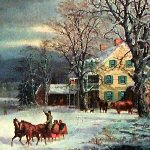
The picture in the upper left corner is a portion of the lithograph Winter in the Country by Currier and Ives.
Whenever Salem goes to the Way Station he always orders his "usual."


