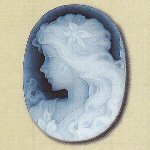
The Cameo
Diane Winters appraised the mid-eighteenth-century sideboard with a critical eye. The dealer's price was too high, considering there were numerous scratches and a few deep gouges on the piece. In addition, some of the original hardware had been replaced with cheap reproductions. Still, it was an exquisite piece of furniture.
"I picked that sideboard up at an estate sale last month," claimed Jonah Pemberly, the elderly man who had a table at the former Puritan Falls drive-in that was now a flea market. "The woman who sold it to me said it had been in her family for over three hundred years."
"It's a lovely old piece," Diane commented. "Too bad it hasn't been properly maintained."
The smile on Pemberly's face became a frown.
"That's made of good solid mahogany."
"Which badly needs to be refinished. Then I would have to locate authentic drawer pulls to replace this inexpensive hardware that obviously came from Lowes or Home Depot."
"I might be able to come down on the price," Jonah reluctantly offered.
After several minutes of haggling, the two agreed on a mutually acceptable figure. Diane then phoned a friend with a truck and made arrangements to have the sideboard delivered to her home.
Slowly—piece by precious piece—the young widowed mother was furnishing her new home with fine antiques. The fact that she would have to put in a lot of hard work to give the old sideboard new life didn't matter. In the end, she would have a superb piece of furniture in her dining room, one she could hopefully enjoy for years to come.
* * *
On Saturday morning, Diane moved the sideboard out to the backyard patio, so she would not have to breathe in the chemical fumes while stripping away the old varnish.
There were four drawers in the sideboard: two long ones in the middle and a narrower but deeper one on each side. She removed the two middle drawers and one of the end ones without any difficulty, but the last drawer wouldn't budge. Finally, she took a slot screwdriver, inserted it in the crack and gently forced the drawer open. When she removed it, something fell to the ground with a ping.
"No wonder it wouldn't open," she said, noticing a false bottom had come loose and jammed the drawer shut.
She bent down and picked up the broach that had fallen out of the drawer.
"How beautiful!" she exclaimed when she saw the delicately carved cameo featuring the profile of a young woman or possibly an adolescent girl.
Diane could tell it was old, and she wondered how long it had been in the sideboard.
"Mommy!" her daughter suddenly cried as she ran toward the safety of her mother's arms.
"What's wrong? Did you fall off the swing?"
The little girl shook her head.
"There was a strange man in the backyard."
Like many parents, Diane had taught her daughter to be wary of strangers. Her eyes immediately went to the swing set.
"Where was he?" she asked.
"Here," Briana replied, pointing to the sideboard. "He was right here, watching you pick up that piece of jewelry."
"Is he still here?" her mother asked.
This wasn't the first time Diane had to deal with her daughter's vivid imagination, and it probably wouldn't be the last.
"No. He disappeared, just like magic!"
"Well, why don't we magically go to the kitchen, and I'll get you some milk and cookies?"
Diane learned from past experience that nothing calmed her daughter as much as Oreos. This time, however, not even the creme-stuffed chocolate cookies could keep Briana's mind off the imaginary stranger.
"He's here," she announced a week later when she and her mother returned to the house after spending the day sightseeing in Boston.
"Again?" Diane asked with a sigh, hoping her daughter would soon outgrow her current phase. "This is the fourth time this week. I'm going to have to start charging him rent."
"I think he wants to talk to you, but he doesn't know how."
"Why would he want to talk to me?" Diane asked, humoring the girl. "I don't even know him."
"He knows us. He's been searching a long time to find us."
Something in her daughter's voice disturbed Diane.
"How do you know all these things?"
"He told me. He can talk to me, but he can't talk to you."
"What does he say?"
"He says he's my daddy, my real daddy."
Diane felt a sharp pain in her heart. Briana's father—her late husband, Brian Winters—had passed away two years earlier when the child was only three. Was this imaginary stranger a delayed result of Briana's grief?
"Do you remember what your father looked like, honey?"
"Yes. His picture is above the fireplace."
"That's right. Does the stranger you see look like your father?"
"No. Daddy had light hair like mine. This man has dark hair, and he wears strange clothes."
"What do you mean by 'strange'?"
"His clothes are ...."
The little girl paused, trying to think of the right word.
"... old-fashioned. Like people wore a long time ago."
"Why would you imagine such a person?"
Too late, Diane realized she had uttered the words aloud.
"I didn't imagine him," her daughter insisted. "I really saw him."
Briana turned away from her mother, and her eyes focused on the sideboard.
"There he is," she cried. "I don't know why you can't see him, but he's right there. He's even brought you a present."
Diane's hand rose to her mouth when she saw a second cameo on top of the sideboard. It hadn't been there a few moments earlier. Her hand trembled as she reached for the broach. There was a quick intake of breath when she saw the features of the face on the cameo.
"Mommy," Briana exclaimed, "it's you!"
"That's impossible!" Diane insisted.
"But it is."
"No, I tell you. It just resembles me somewhat."
Briana wanted to argue the point, but her mother would hear no more on the subject of the second cameo.
* * *
The following morning Diane took her daughter to a diner for a pancake breakfast, a little ritual they often enjoyed on Sunday mornings. Afterward, she stopped at the Puritan Falls flea market. Briana was eager to go home and play, but her mother promised they wouldn't be in the shop for long.
"Hello there," Jonah Pemberly called when the mother and daughter neared his table. "How's that sideboard coming along?"
"Refinishing was a time-consuming job, but it looks beautiful," Diane replied, "and I think I found just the right drawer pulls on eBay."
"What are you in the market for now? I just got in a gorgeous Queen Anne mantel clock if you're interested."
"Actually, I'm not here as a buyer today."
"Oh? Have you got something you'd like to sell?"
"No, I was looking for some information."
Diane opened her purse and took out the two cameos.
"Can you tell me anything about these two pieces of jewelry?"
Jonah picked up a magnifying glass and examined first one cameo and then the other.
"I'm not an expert on jewelry, mind you," he prefaced his appraisal, "but I'd say these cameos date back to the early seventeen hundreds. They appear to be made of whalebone, and the backgrounds were dyed dark so that the white faces would be more noticeable."
"Whalebone? Was that a common material back then?"
"With a number of the local artists, yes, but mostly with whalers and merchant seamen. These men were at sea, away from home for long periods of time. Some dabbled in scrimshaw engravings and carving while on their voyages."
"Is there any way of finding out who carved these cameos?" Diane asked.
"They're not signed, so your best bet is to try to trace them back from their previous owner. Where did you get them?"
"They were in the sideboard you sold me."
Diane decided not to reveal the circumstances under which she found the second cameo.
"You said you got it at an estate sale, didn't you?"
"Yes," Jonah replied, "and the woman I bought it from swears it had been in her family for generations. I can give you her name and phone number, and perhaps she can provide you with a more detailed history."
* * *
The following Saturday, after dropping Briana off at a friend's birthday party, Diane headed toward the town of Beverly where Miriam Lockwood, the former owner of the sideboard, agreed to meet her.
"I can't thank you enough for seeing me," Diane told the elderly woman who was in the midst of piles of cardboard boxes, "especially since you're in the middle of packing."
"Actually, I just moved to Beverly and am in the process of unpacking my things."
"Still, you must be extremely busy."
"And you've given me an excellent excuse to take a break from my labors. Why don't you come into the kitchen and have a cup of coffee?"
"I don't want to put you to any trouble."
"Nonsense! I'm in desperate need of a caffeine fix right about now."
After the two women became acquainted, Miriam brought up the matter of the visit.
"I understand you were the customer who purchased my mother's sideboard?"
"Yes," Diane replied and reached into her purse for the cameos, which had been carefully wrapped in tissue paper. "And I found these inside it. They were apparently hidden beneath a false bottom in one of the side drawers."
"That's odd!" the woman declared. "I've opened those drawers hundreds of times over the years, but I never noticed anything out of the ordinary. And I'm sure my mother would have taken them out and worn them if she knew they were there."
"Do you know where the sideboard originally came from?"
"I believe it belonged to the man who built my mother's house, a sea captain by the name of Caleb Beckett."
"Do you know roughly when this Captain Beckett was born?"
"Oh, he goes way back. He was one of the early settlers in Massachusetts. He didn't come over on the Mayflower, but he was here long before the American Revolution. I believe his family emigrated from England in the 1660s. Anyway, Caleb was born around 1670, give or take a few years. According to our family history, he went to sea at an early age. Apparently, he never married and was nearly eighty years old when he finally built his house and filled it with all the treasures he'd collected during his many voyages."
"If he never married, who did he leave the house to?"
"A nephew, the son of his younger brother. It's been passed down from father to son, generation after generation, ever since. I was an only child, so the house came to me."
There was a note of sadness in the old woman's voice.
"I don't have any children. You see, my husband died at an early age. We always wanted a big family, and we foolishly thought we had a lifetime ahead of us."
Diane touched the older woman's hand in a gesture of compassion.
"I lost my husband, too."
"I never remarried," Miriam continued. "I recently retired and decided to downsize, so I sold the family house to a nonprofit organization that is going to restore it and open it as a museum."
"Do you know if this sea captain ever made any carvings or scrimshaw while he was at sea?"
"I really can't say. If he did, there were no samples of his work left in the house."
"Except possibly these two cameos," Diane concluded.
* * *
Before returning to her own house, Diane stopped in Salem at the building that was once the home of Captain Caleb Beckett. Although the place was currently closed for renovations, she was allowed inside, at the request of Miriam Lockwood, the former owner. She was greeted by an interior decorator who was trying to piece together several scraps of the original wallpaper uncovered in the dining room in order to replicate the pattern as accurately as possible.
"I really hate to interrupt your work," Diane apologized.
"No problem. In fact, I was just about to call it a day. I've been here since six this morning. Now, what is it you wanted to see?" he asked.
"I was told there was a portrait of the original owner of the house, Captain Caleb Beckett."
"Oh, yes. It's back in what used to be the formal parlor but what is now being used as a storage area while the building undergoes renovation."
The decorator led her to a large room filled with furnishings and artwork, all hidden under protective tarps.
"Now, where did I see that painting?" he asked himself as he walked through the narrow passages between the furniture.
Diane waited several minutes before he announced triumphantly, "I found it."
The young man carried the large framed portrait from the back of the room and placed it in front of Diane. Then he lifted the tarp and uncovered the painting beneath. Despite the long years and doubtless hard life at sea, Caleb Beckett was a remarkably handsome man—assuming the artist remained true to his subject.
"He doesn't look like a sea captain," the decorator commented. "He looks more like a prosperous businessman or a wealthy landowner."
"Do you mind if I take a photograph of the painting?"
"Go right ahead."
Diane pointed her cell phone at the portrait and took several pictures. She thanked the decorator for his trouble, made a modest contribution to the nonprofit organization that had purchased the house and then left Salem to return home.
* * *
After dinner, while Briana was playing with a talking picture book her grandmother had sent her from Florida, Diane downloaded the photographs from her cell phone onto her laptop.
"Mommy, what kind of animal is this with the striped tail?" the little girl asked, carrying the book over to her mother.
"That's a lemur. Isn't he cute?"
But Briana's eyes had drifted from the talking picture book to her mother's computer screen.
"That's him!" she cried excitedly. "I told you I didn't imagine him."
"Are you sure this is the man you saw the day I found the cameo?"
"I'm positive!"
"Okay," Diane said, finally accepting the presence of a ghost in her home. "Now I know who he is; I just have to find out what he wants."
"Oh, that's easy," Briana told her. "He wants to be with his wife and daughter—us."
* * *
Before encountering the ghost of Captain Caleb Beckett, Diane had never believed in the paranormal. She never consulted a fortuneteller or had faith in horoscopes. Still, she always believed in keeping an open mind, and she could hardly deny what seemed to be irrefutable proof that the sea captain's spirit appeared to her daughter on more than one occasion.
As most members of this modern, technological generation do, she hoped to solve her problem by consulting the Internet. A quick search produced the telephone number of Vera Sharpe, a professor at UMass in Essex Green who claimed to be a successful spiritual medium.
The following Friday, while Briana was in school, Professor Sharpe, accompanied by two students, visited Diane's home to investigate her claim of a ghost in the house.
"Should we sit at the table and hold hands?" the homeowner asked.
The professor and her students chuckled.
"That won't be necessary; this isn't Hollywood," Vera said politely. "Why don't we just make ourselves comfortable in your living room?"
The professor drank from her bottle of Dasani while her students set up state-of-the-art audio and video equipment to record any detectable supernatural activity.
"I think we're all set," one of the students announced.
Vera put down her bottle of water, closed her eyes and let her body relax.
"There's been a significant drop in temperature," one of the students noted.
Diane didn't need to be told that. She was already shivering from the cold.
When, at last, the medium spoke, there was frost on her breath.
"Sarah, my beloved, I have waited so long to see you again."
Could the voice, which was much deeper than the professor's, belong to Captain Caleb Beckett?
"Who is Sarah?" Perry, the more experienced of the professor's two students, asked the person speaking through the medium.
"She is the woman I love, the mother of my child. She is here in this room."
The two students turned and looked at Diane.
The spirit of Caleb Beckett spoke again, this time directly to the woman he claimed was his beloved Sarah.
"I know the truth," he said. "The child you bore is mine."
"No!" Diane cried. "I'm not Sarah, and Briana is not your daughter!"
"It doesn't matter what name you go by now, my dearest. You are my Sarah, and the girl is my daughter. I may have failed you both once, but I won't fail you again."
The professor's head suddenly slumped forward, and the room gradually returned to its normal temperature.
"Is that all?" Diane asked with disappointment.
"This is the first attempt at contact," Perry explained. "The spirit is probably drained of energy at this point. We'll have to wait a few days before we try again."
"Do we have to contact it again?" Diane asked, preferring to think of the ghost as a thing rather than as a man. "Can't we just get rid of it?"
"And how do you propose we do that?" the professor asked wearily.
"I don't know. Sprinkle holy water around the house, perform an exorcism or do something along those lines."
"We're not dealing with a demon, Mrs. Winters. This is the tormented soul of a man who once breathed and walked the earth. If you want him to leave you alone, then we have to discover what he wants so that he can rest in peace."
"He wants me and my daughter!" Diane cried. "And he can't have either one of us!"
"Then it will be up to us to convince him of that," Vera said.
Diane had hoped that by calling in a medium, she could quickly get rid of the unwanted entity, but the professor informed her that it could take months or even years.
"Maybe it would be best if Briana and I just move," she said with frustration.
Vera shook her head.
"Relocating wouldn't do any good. He's haunting you, not the house. If you move, he'll simply follow you to your new home."
* * *
Later that night, as Briana lay sleeping peacefully in her canopy bed, her mother paced the living room floor, unable to stop thinking about Captain Caleb Beckett. All the trouble had started when she found the first cameo in the drawer of the sideboard.
That's it! she thought. If I destroy the cameos, maybe that will get rid of the ghost.
Diane went to the master bedroom, opened her jewelry box and removed the hand-carved broaches, looking at the faces one last time. With a good deal of reluctance, she finally admitted to herself that the features of the face on the second cameo looked exactly like her own. What she hadn't noticed before was that the face on the first cameo was Briana's, or at least what her face would probably look like in a few more years.
"I don't understand any of this!" she cried.
"You've been reborn, the both of you."
The deep, masculine voice startled Diane, and she had to stifle a scream so as not to wake her daughter. Less than two feet in front of her a shimmering mass of ectoplasm was taking the shape of Captain Caleb Beckett.
"Why won't you leave us alone?" the widow tearfully pleaded with the ghost.
"I've waited more than three hundred years to see you again, Sarah."
"Stop calling me that!" she demanded. "My name is Diane. Diane Winters."
"You were first born Sarah Solart. Your father was an innkeeper in Wenham. We were in love and planned to marry. I went away to sea and was expected to be back within a few months, but a storm swept the ship off course. When I came back to Salem two years later, I learned you had married William Good. I was heartbroken and immediately signed on aboard another ship. I sailed around the world, trying to forget you.
"Then one day, while in port in Liverpool, I received news of the dreadful trials going on in Salem. I came home at once, but I was too late. They had already hanged you as a witch. It was then I learned that you had a daughter who was imprisoned for witchcraft as well. I went to the gaol to see her, and I knew her face at once. It was so like my mother's and sister's. After seeing Dorcas, I understood why you married William Good: you were with child at the time, my child.
"Although you were beyond man's help, I swore to save our daughter. When Governor Phips dissolved the Court of Oyer and Terminer, the executions stopped. I paid Dorcas's prison costs, and she was set free. I couldn't claim her as mine because everyone believed her to be William Good's child, and I had no proof otherwise. I had no way of knowing that the months she spent in prison had destroyed her mind and that she would never be mentally older than five years."
The ghost of Caleb Beckett uttered a cry, one that held three hundred years' worth of grief. Then he wept silently for several minutes before concluding his tragic tale.
"I went back to the only life I knew: the sea. Still, I returned to Salem from time to time and looked in on Dorcas. She was a beautiful girl, just like her mother. Then one year I came back, and she and William were gone. I never learned what happened to them.
"During my long, lonely years at sea, I carved your image and hers on whalebone, so I would always have you both with me. I prayed that someday God, in his mercy, would reunite us, and at long last he has."
Centuries of love shone with a warm glow on Caleb Beckett's handsome face, and Diane felt the first stirrings of emotion in her heart.
"Now, nothing will ever part us again," the spirit declared.
Sarah Good's reawakening feelings for Caleb Beckett, however, paled in comparison to Diane's maternal devotion to her daughter, Briana.
"You can't have my baby."
"She's my child, too."
"No! Dorcas may have been your daughter, but Briana isn't."
"They share the same soul," Caleb reasoned.
"But the soul is in Briana's body. My heart aches for what poor Dorcas was forced to endure, but that was three centuries ago! Her life—good or bad—has long since ended. You can't correct the mistakes of the past, and I won't let you destroy Briana's chance for a full and happy life."
"I don't want to make our child unhappy," Caleb argued. "I only want what's best for her."
"Then go, and leave us be. Briana may share a soul with your Dorcas, but she is a different person in this life. She was born into a different time than yours. I'd like to see Briana get an education, have a career, get married and have a family of her own. How can she do that with a ghost laying claim to her immortal soul?"
Diane saw the look of agony on the captain's face and took pity on him.
"It's obvious you loved Sarah and Dorcas very much," she said, her voice much softer than before, "but don't you see that you can't have them back? Not in this life anyway."
The shimmering form of Captain Caleb Beckett began to grow duller, and his features became more transparent.
"Yes," he said sadly, "maybe God, in his great wisdom, has a different life planned for you and Dorcas this time. But who knows? Maybe someday, in another life, the three of us will finally be given a chance at happiness together."
Caleb Beckett's final words echoed in the room long after his revenant was gone.
* * *
Briana's life was as full and as happy as her mother had hoped it would be. The young woman successfully balanced a career as a bestselling novelist with a rewarding personal life as a wife and mother of three. She never learned about her spiritual connection to Dorcas Good, although she often dreamt of a handsome sea captain who loved her like a father.
As was the case with Miriam Lockwood, the retired history teacher from Beverly who became a good friend until she died at the age of ninety-four, Diane Winters never remarried. She was content to be a mother and a grandmother and to reminisce about the memories of her brief but happy marriage to Brian Winters.
From time to time, Diane would drive to Salem and wander through the museum that was once the home of Captain Caleb Beckett. When she did, she would stand before the captain's portrait, stare up into his handsome face and recall his final words to her.
"Yes, my dearest Caleb," she would whisper as she lovingly touched the two cameos she wore pinned to the lapels of her jacket, "someday we will be together."
Although the events of this story are fictional, Sarah Good (wife of William Good) was hanged as a witch in Salem. Her five-year-old daughter, Dorcas, was also accused and spent nine months in prison. It is said that because of her ordeal, she always had the mind of a five-year-old.
Why is it all my gifts from Salem have a black cat on them?


